
This post contains affiliate links. If you book through one, I may earn a small commission at no extra cost to you — it helps keep Jet Lag Jelly running. Read my full affiliate disclosure for more.
Vietnam had been on my list for a long time. Not the “maybe someday” kind of list — the “I will make this happen” kind. And Northern Vietnam specifically kept calling: the chaos of Hanoi, the misty mountains of Sapa, and Ha Long Bay — one of those places that looks so unreal in photos that you half expect to arrive and find out it’s CGI. Spoiler: it’s not CGI. It’s better.
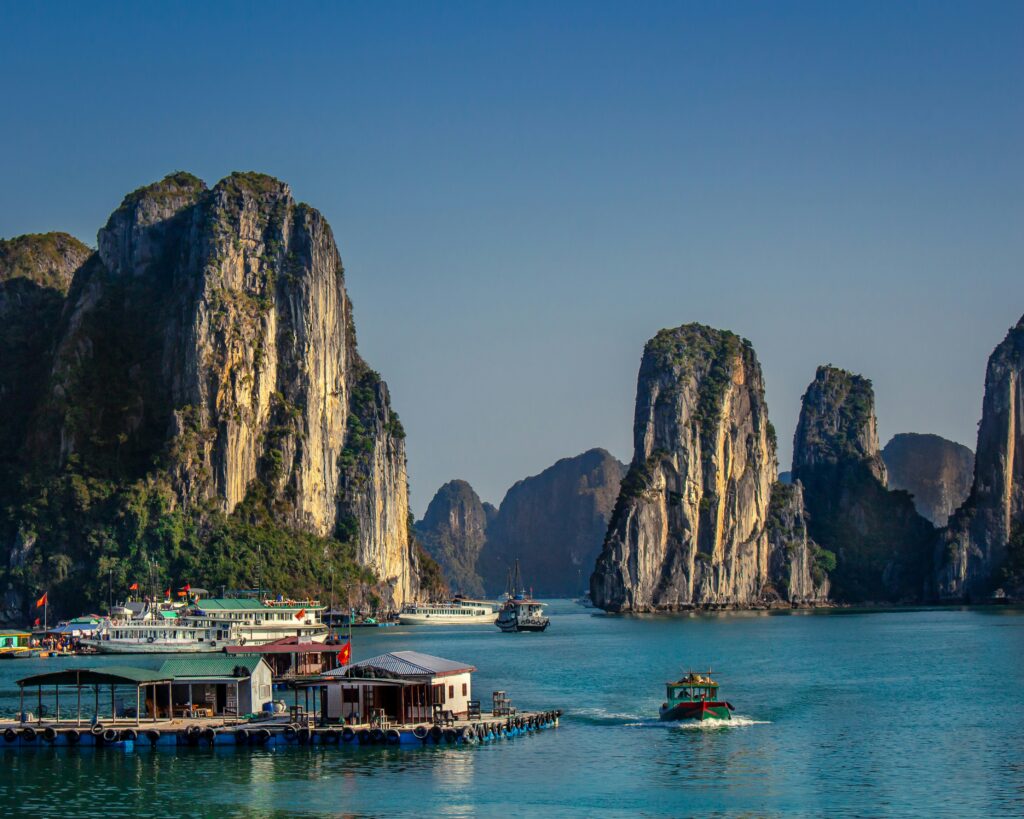
This is the story of how Northern Vietnam completely exceeded every expectation, delivered chaos and calm in equal measure, and somehow managed to feel both overwhelming and deeply peaceful at the same time. Often on the same day.
Grab a coffee. Let’s go.
Day 1: Hanoi — Chaos, Coffee, and Absolutely No Personal Space
Hanoi Itinery
1.Old Quarter
2. Train Street
3. Hoan Kiem Lake
4. Ngoc Son Temple
5. Ba Dinh Square
6. Ho Chi Minh Mausoleum
7. Ho Chi Minh Presidental Palace
8. One Pillar Pagoda
9. Tran Quoc Pagoda
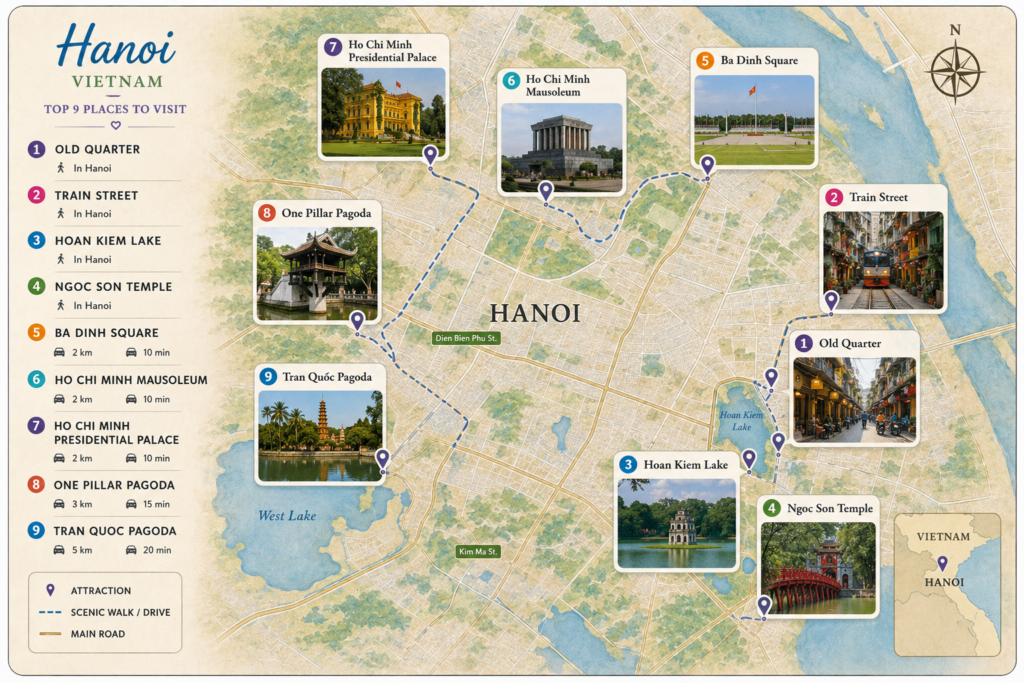
Nothing prepares you for Hanoi. Not the research, not the photos, not the travel blogs. You just have to step outside and let the city happen to you.
The first day was simple — just walking, absorbing, and trying not to get hit by a motorbike. Hanoi’s Old Quarter is one of those places where every street has its own personality, its own smell, and its own completely unexplained level of noise. It’s overwhelming in the best possible way.
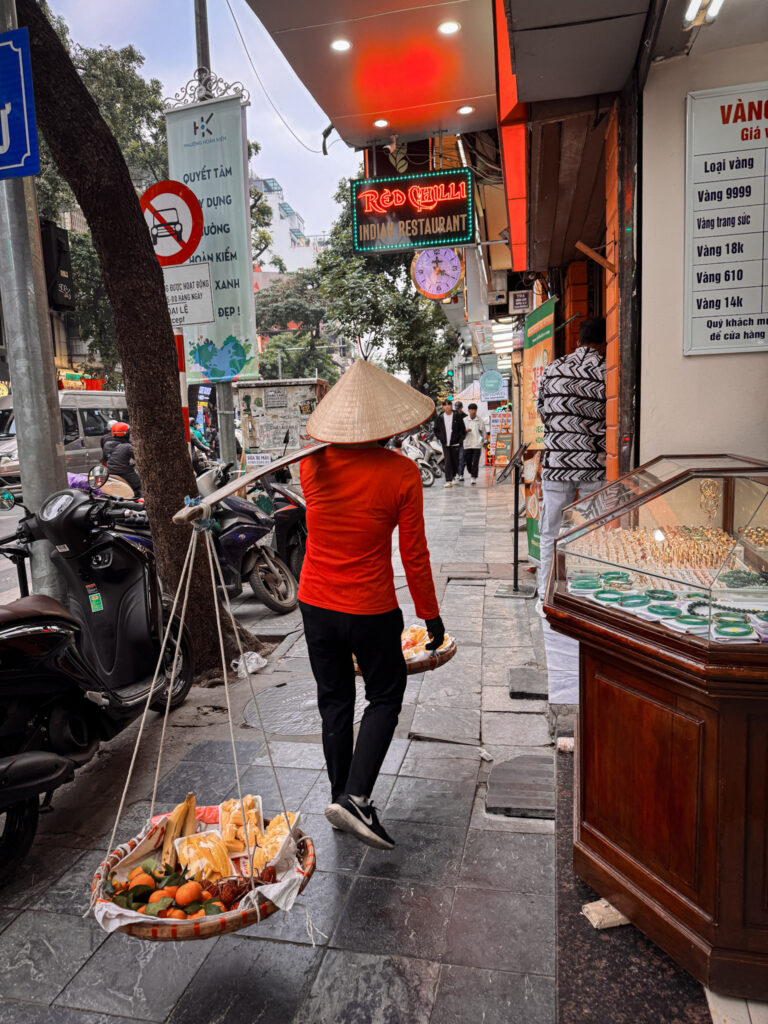
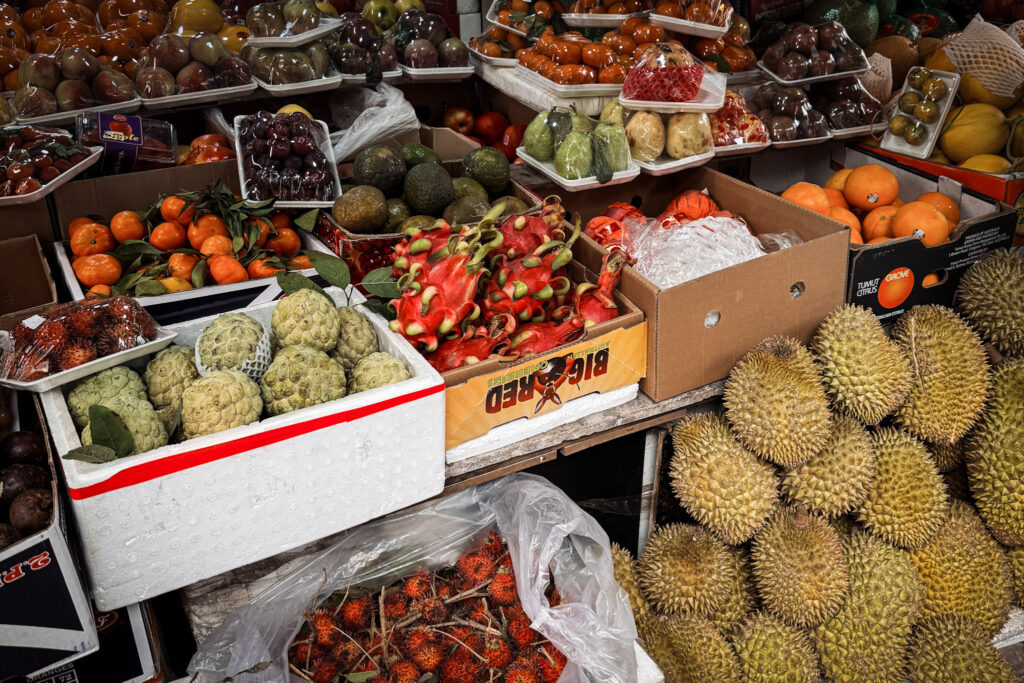
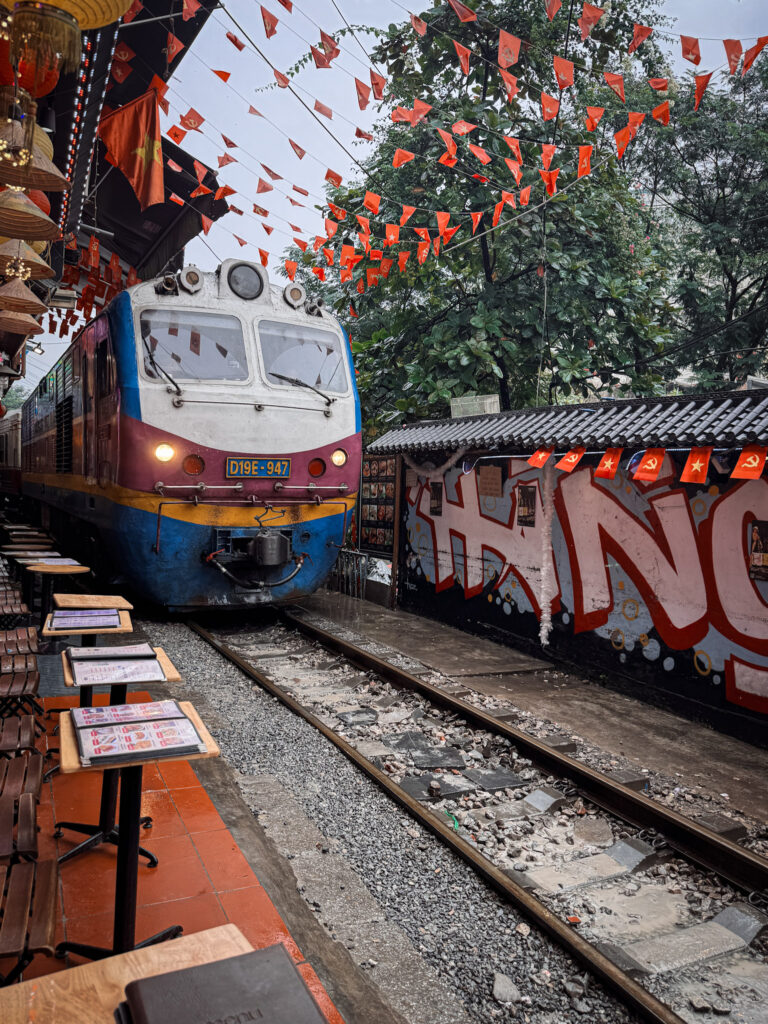
The highlight? Train Street. A narrow alleyway where an actual working train passes just centimeters from the café tables lining both sides. We grabbed a drink, found a spot, and waited. When the train finally came — and it comes fast — the whole street erupted. Half the crowd screamed, half laughed, everyone took seventeen photos. Absolutely worth it.
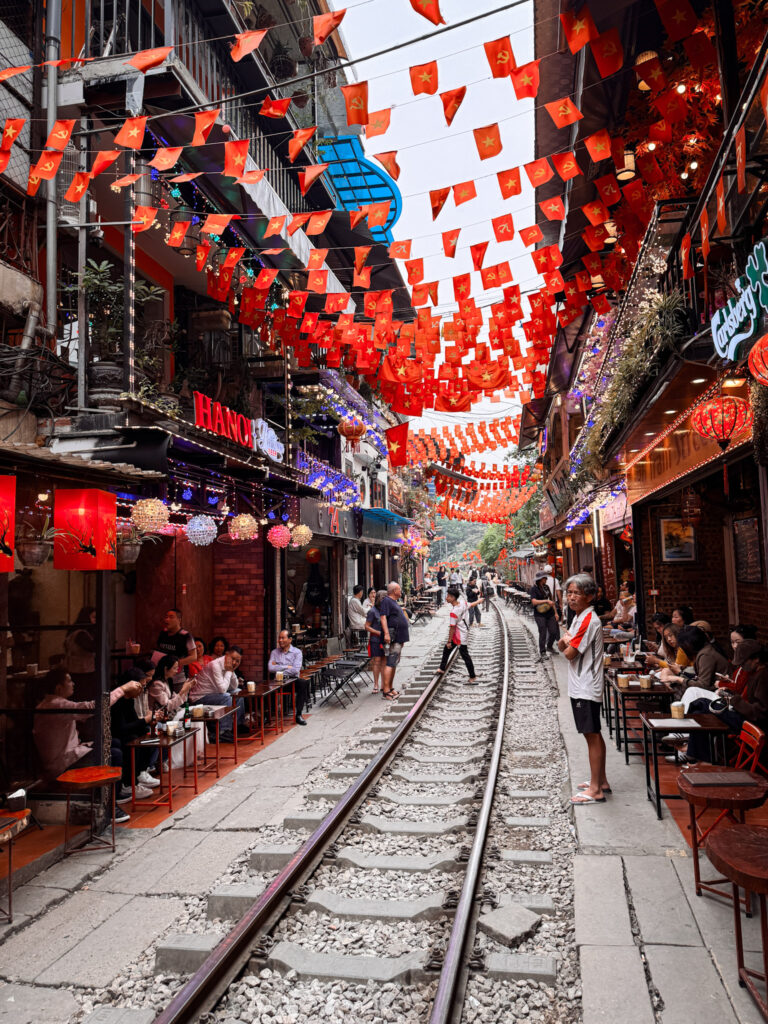
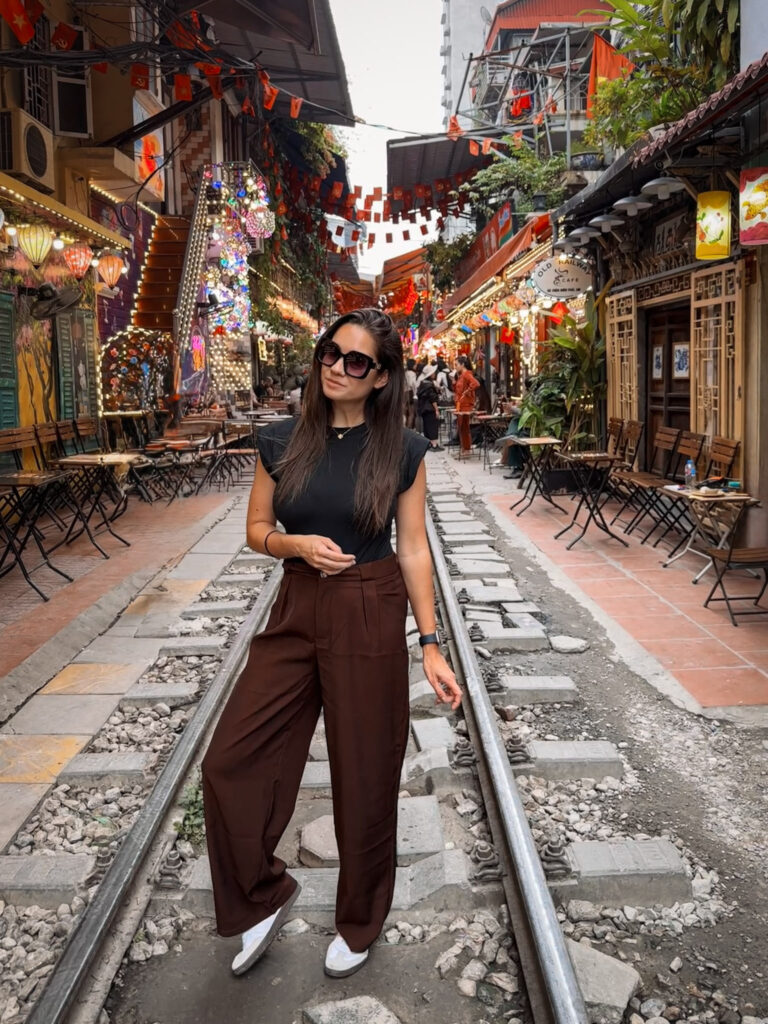
Useful Information: Train Street is free to enter but access is managed through licensed cafés — a café owner will escort you in and you're expected to buy a drink (around 30,000 VND). Group tours have been banned since March 2025 so independent visitors only.

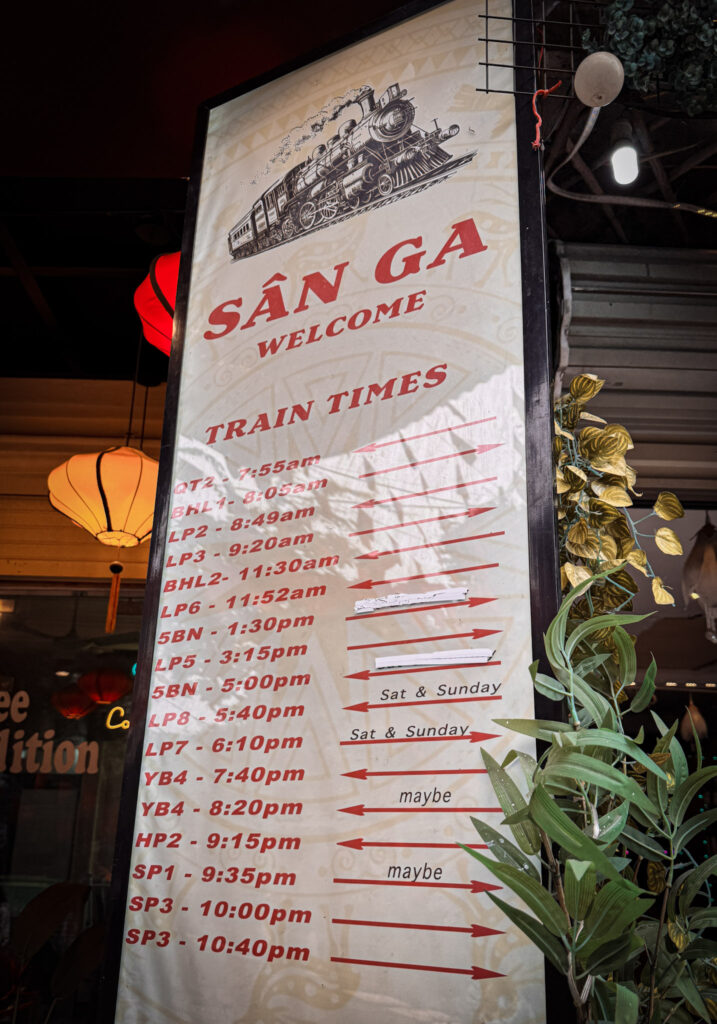
Check the latest 2026 visitor guide and train times here before you go, as schedules change frequently — but as a rough guide, trains pass on weekday evenings at around 7pm, 7:45pm, 8:30pm and 9:30pm, with more frequent passes on weekends throughout the day. Always confirm the exact time with café staff when you arrive.

Jet Lag Jelly Tip: Go for the evening session on a weekday — fewer tourists than weekends, the café lights and atmosphere are more dramatic after dark, and the 7pm train is reliably the busiest and most spectacular one to watch.
Day 2: Hanoi — Lakes, Temples & History Around Every Corner
Day 2 slowed things down in the best possible way. A morning walk around Hoan Kiem Lake is one of those simple travel pleasures that somehow ends up being a highlight of the whole trip. Locals doing tai chi, couples on benches, street vendors, and the city slowly waking up around a perfectly still lake. Unhurried and lovely.
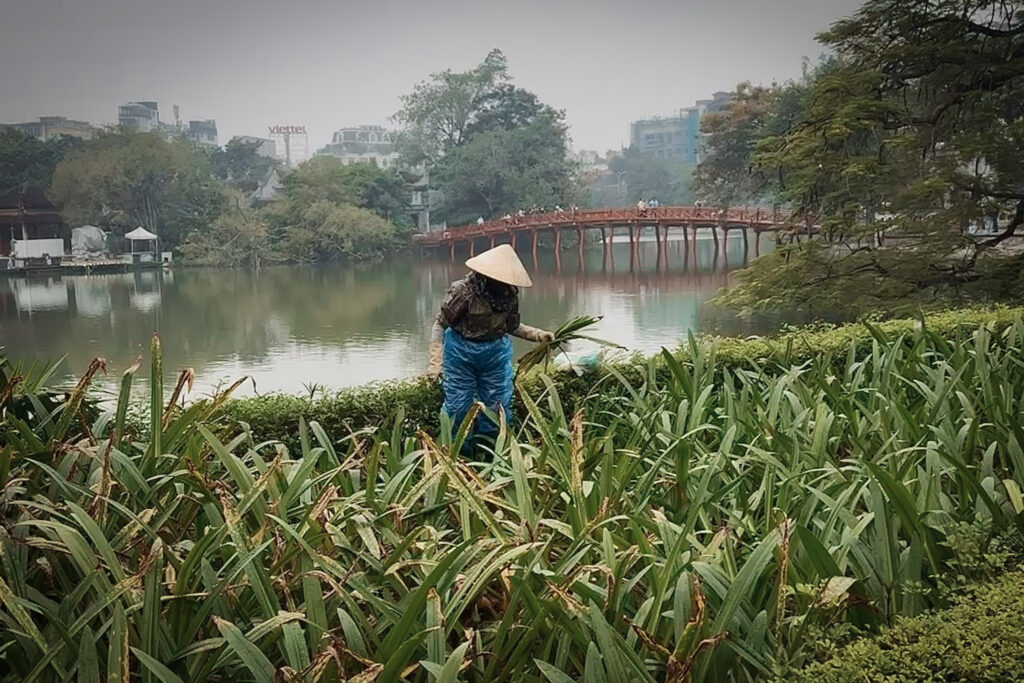
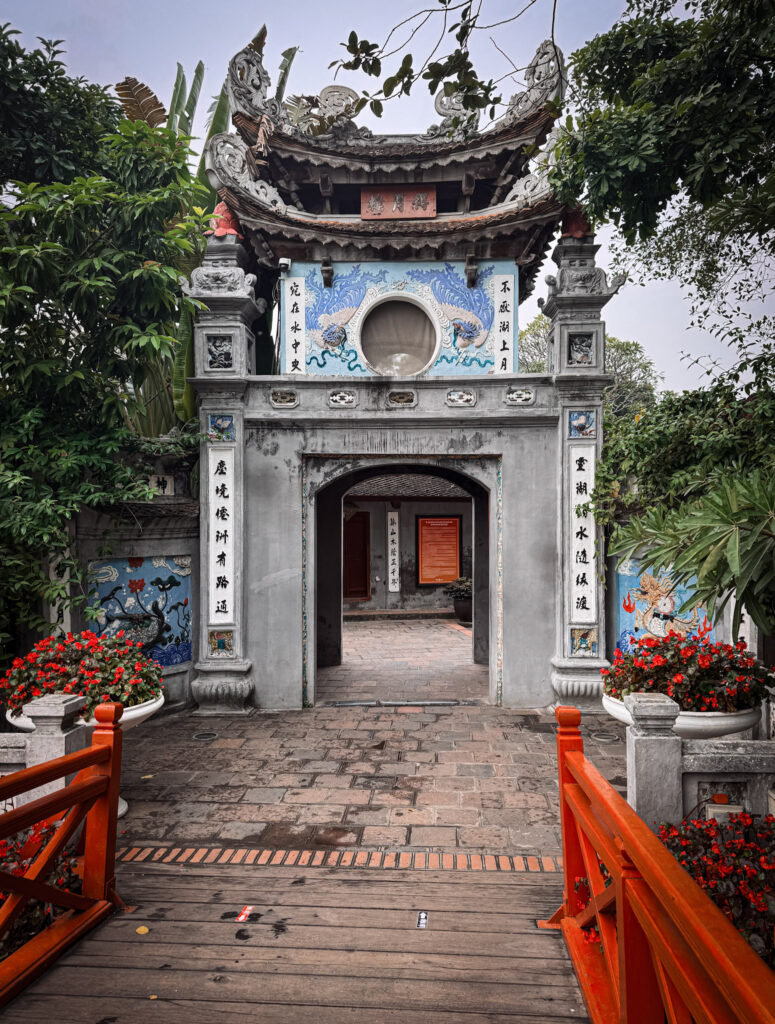
In the middle of the lake sits a tiny island connected by a bright red bridge — home to Ngoc Son Temple. The bridge itself, called The Huc, translates to “Morning Sunlight Bridge” — which tells you everything you need to know about the best time to visit. The temple is small, peaceful, and completely charming, dedicated to General Tran Hung Dao and housing the preserved body of one of Hoan Kiem’s legendary giant turtles. The kind of place that feels like a reward for showing up early.
Useful Information: Entry is 30,000 VND (around $1.20 USD), open daily 8am to 6pm. If you're staying in the Old Quarter it's a short walk — just head to the northern end of the lake and cross the red bridge.
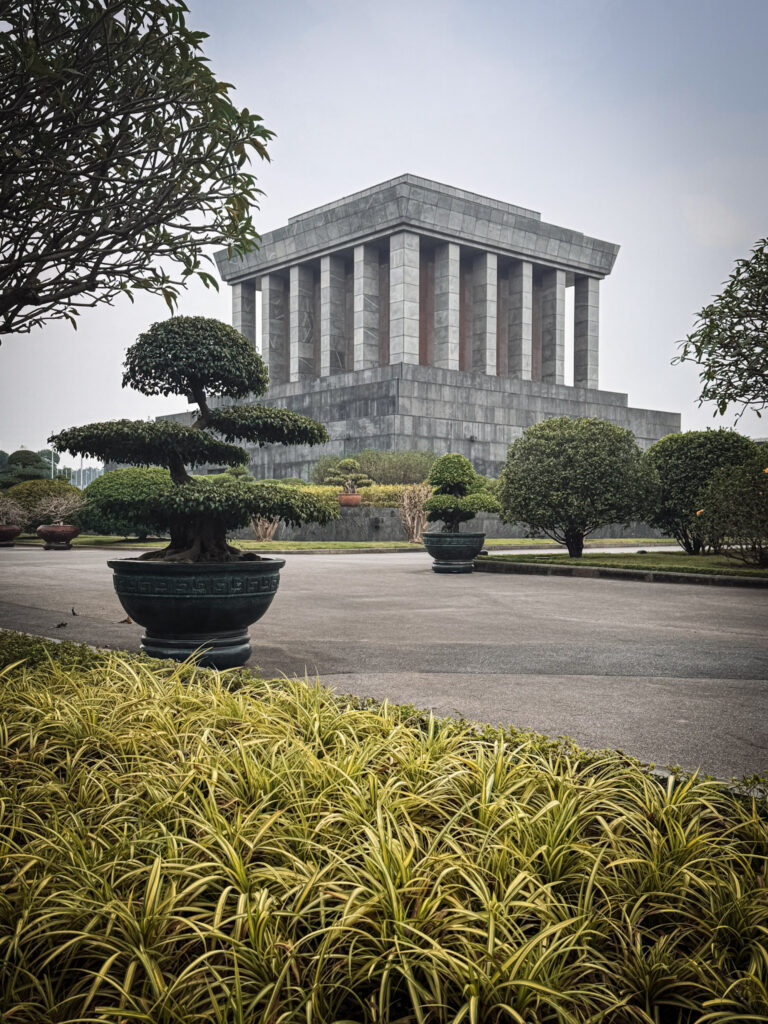
From there, the day took a more historical turn. Ba Dinh Square and the Ho Chi Minh Mausoleum carry a completely different weight. The grand granite structure is serious, imposing, and historically significant — this is where Ho Chi Minh declared Vietnamese independence on September 2, 1945. Even walking around the outside, the atmosphere stops you in your tracks.
Useful Information: Entry is free, open Tuesday to Thursday and weekends, 8am to 11am (until 11:30am on weekends). Closed Mondays and Fridays. Also closes for approximately two months every autumn (usually October–November) for maintenance — always check before visiting. Strict dress code applies: shoulders and knees must be covered, no hats inside. Cameras, phones and bags must be deposited before entering. No photography allowed inside the mausoleum itself.

Jet Lag Jelly Tip: Arrive early — queues can get very long by mid-morning, especially on weekends. The whole Ba Dinh complex is worth at least a half day if you also visit the nearby Ho Chi Minh Museum and the One Pillar Pagoda just a short walk away.
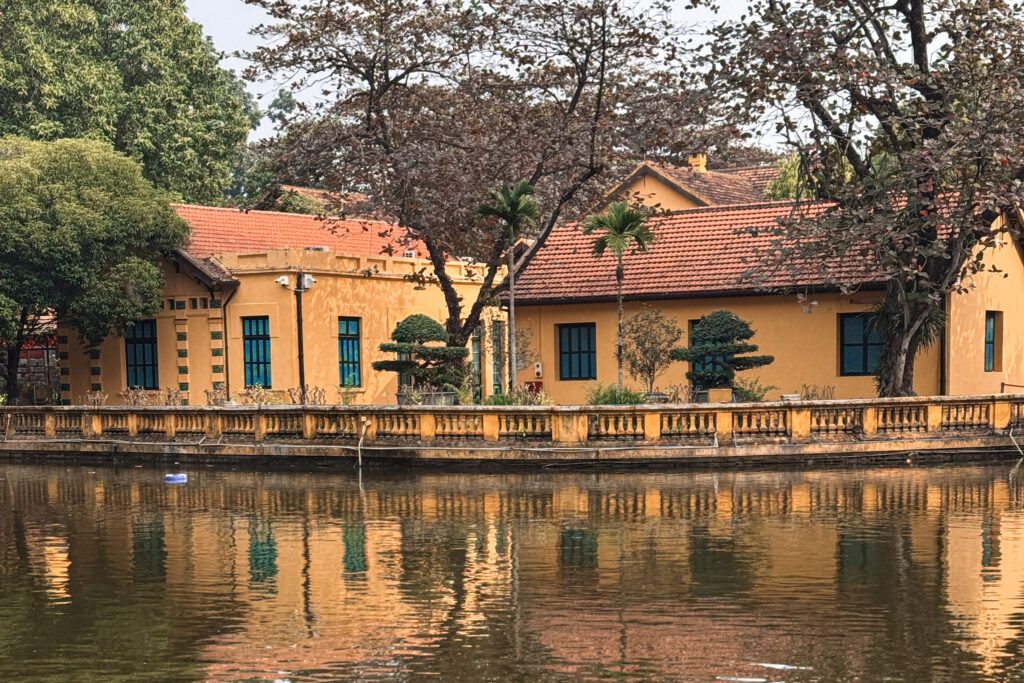
Just within the same grounds, the Ho Chi Minh Presidential Palace delivered an unexpected moment of beauty. The mustard-yellow French colonial building reflected perfectly in the surrounding pond, framed by trees in bloom. One of those accidental photography moments that ends up being one of your favorite shots of the entire trip.
Useful Information: The palace itself is not open to the public — it's still used as a working government building — but the surrounding grounds, Ho Chi Minh's modest stilt house, the carp pond, and the famous Mango Alley are all open to visitors. Entry is 40,000 VND (around $1.60 USD). Open daily except Monday and Friday afternoons — summer hours 7:30am to 11am and 1:30pm to 4pm, winter hours 8am to 11am and 1:30pm to 4pm.

Jet Lag Jelly Tip: The contrast between the grand, opulent palace and the tiny stilt house Ho Chi Minh actually chose to live in is one of those details that genuinely makes you stop and think. Don't miss the stilt house — it tells you more about the man than any museum exhibit could.
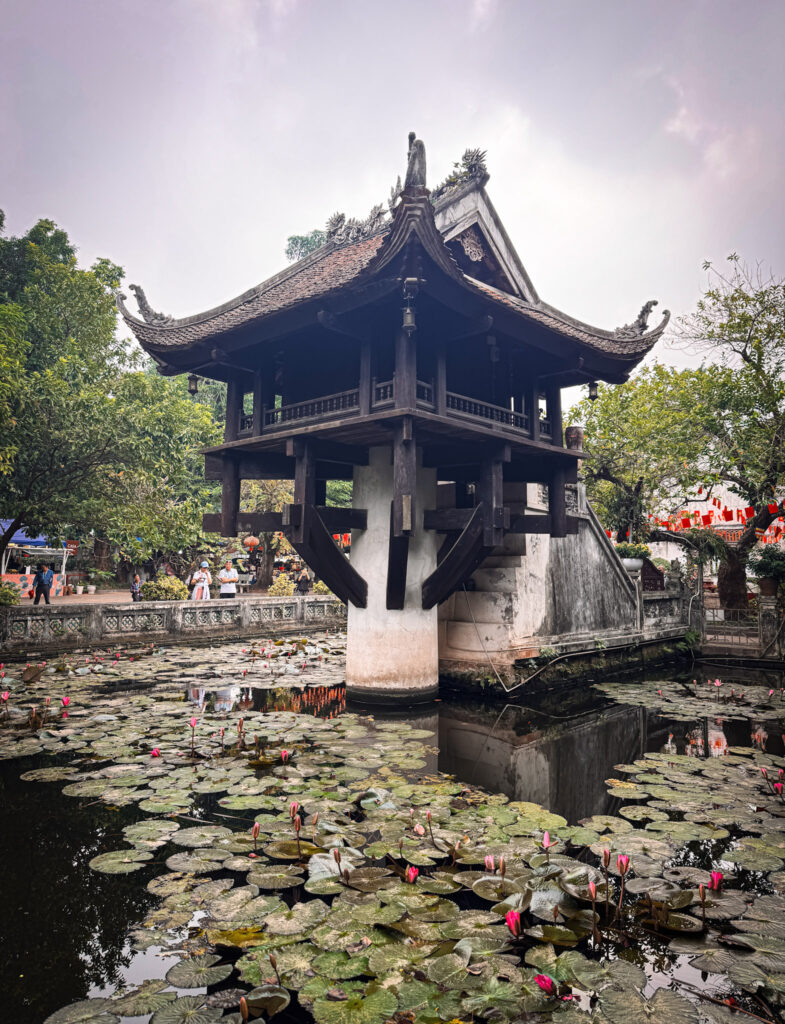
Just steps away sits One Pillar Pagoda — one of Vietnam’s most iconic structures. A tiny wooden pagoda sitting on a single stone pillar rising from a small lake, built in 1049 during the Ly Dynasty. It looks like it shouldn’t work architecturally. It absolutely does. The pagoda was designed to resemble a lotus blossom rising from the water — a Buddhist symbol of purity emerging from suffering — which makes the whole thing even more beautiful once you know it.
Useful Information: Free entry, open daily 8am to 5pm. Dress code applies — shoulders and knees must be covered. Located right next to the Ho Chi Minh Mausoleum, so easily combined in the same visit.

Jet Lag Jelly Tip: Stand back and look at it from a distance first before walking up close — the full lotus-on-water effect is most visible from the path leading up to it, and it's one of those compositions that rewards the wide shot more than the close-up.
Jet Lag Jelly Tip: The Mausoleum, One Pillar Pagoda, and Ho Chi Minh Museum are all within walking distance of each other — do them all in one morning and you'll feel very efficient. Reward yourself with pho afterwards. You've earned it.
Day 3: Sapa — Misty Mountains & The Best Instagram Spot in Vietnam
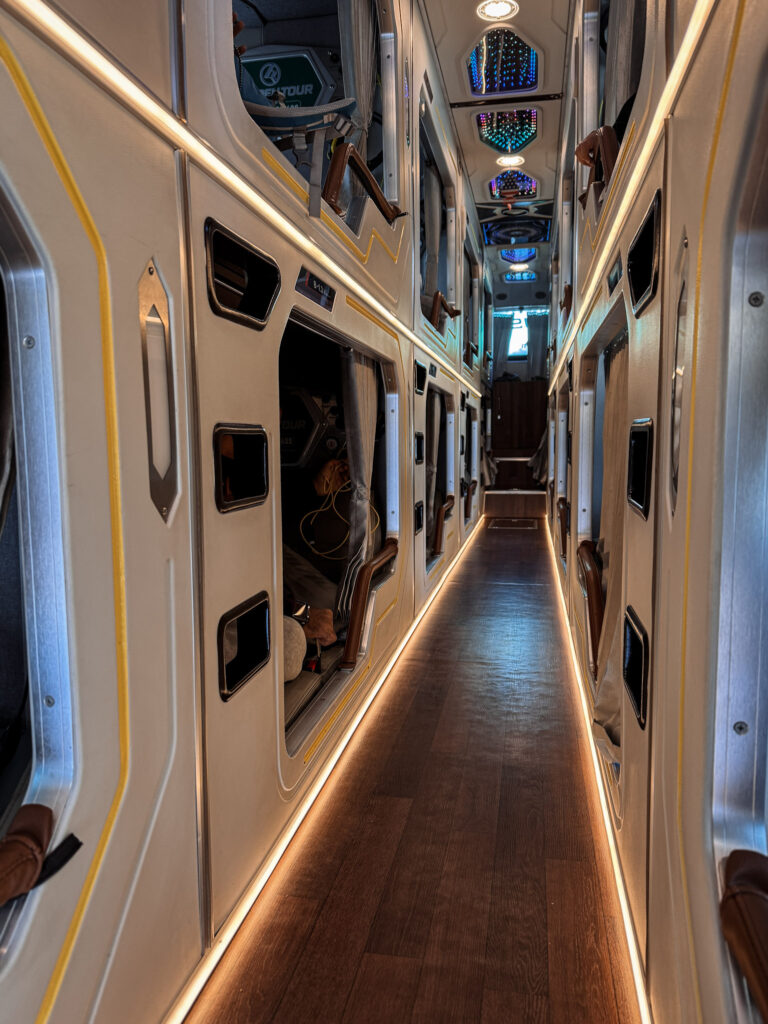
Getting to Sapa involves an overnight sleeper bus from Hanoi — and honestly, it’s part of the experience. Comfortable enough, scenic enough, and just adventurous enough to make you feel like a proper traveler. Did I sleep? Technically no. But that’s less about the bus and more about the fact that I apparently cannot sleep anywhere that isn’t my own bed. The mountains don’t care about your sleep schedule though. They just show up, misty and dramatic, and you forget you’re tired.
Useful Information: The overnight bus from Hanoi to Sapa takes around 5.5 to 6.5 hours via the Hanoi–Lao Cai Expressway. Most buses depart from Hanoi's Old Quarter between 9pm and 11pm, arriving in Sapa in the early morning. Tickets start from around $17–18 USD for a single sleeper cabin, with free hotel pickup in the Old Quarter included by most operators. The best-rated options are Sao Viet (the only bus with an onboard toilet) and HK Open Tour (most popular with international travelers, free Old Quarter hotel pickup). Book at least 1–2 weeks ahead during peak season (November to January)in GetYourGuide.

Jet Lag Jelly Tip: Book the overnight sleeper bus from Hanoi to Sapa rather than the train — the bus drops you directly in Sapa town, while the train station is outside of Sapa and requires additional transport to get there. One less thing to figure out after a sleepless night in the mountains. It's comfortable, affordable, and saves you a night of accommodation. Just maybe bring an eye mask and accept that sleep is optional.
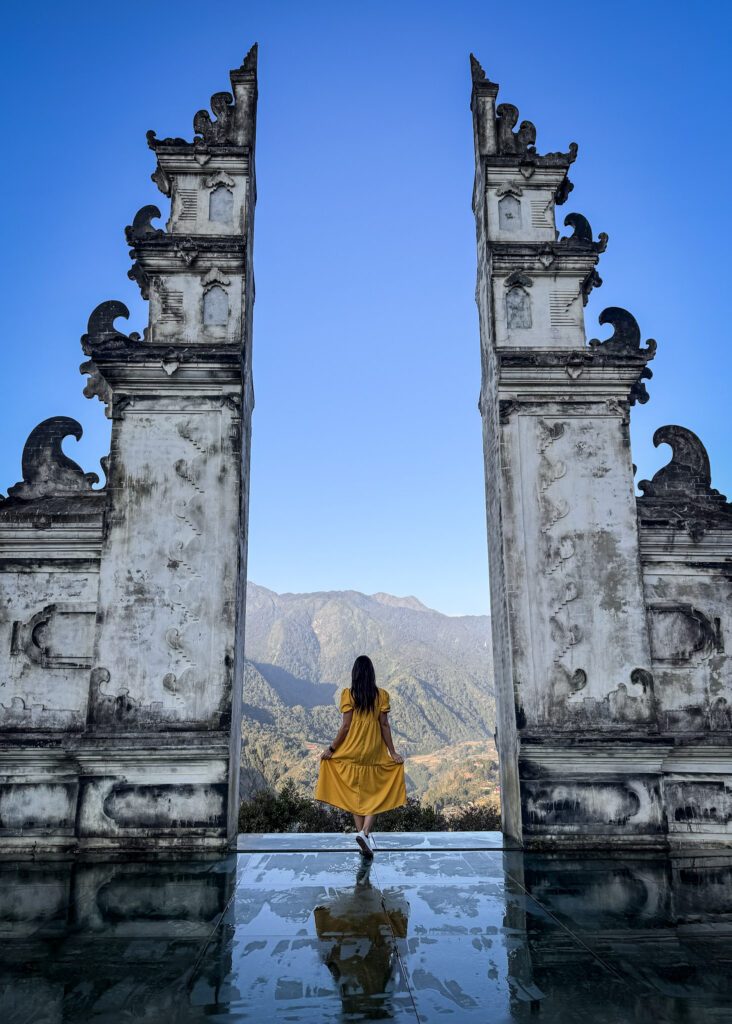
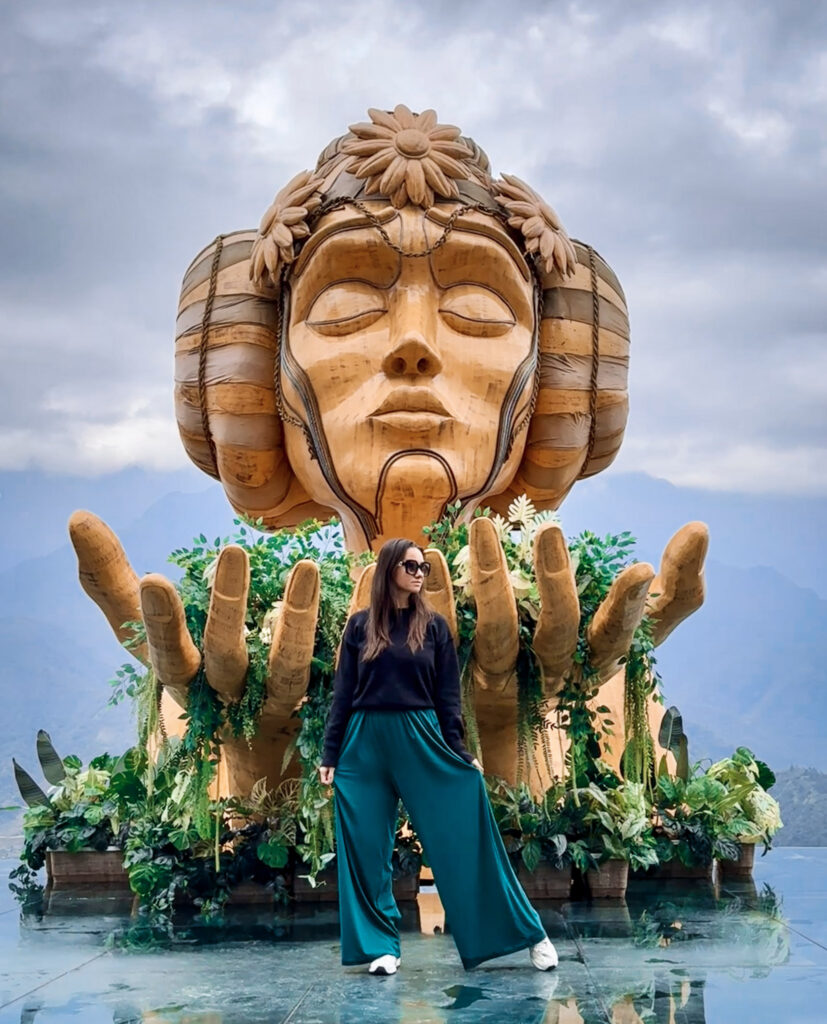
First stop of the day — Moana Sapa, and honestly it deserves its own paragraph, its own blog post, and possibly its own Instagram account. Often described as “miniature Bali in the mountains,” this stunning viewpoint complex is basically a photographer’s dream come true.
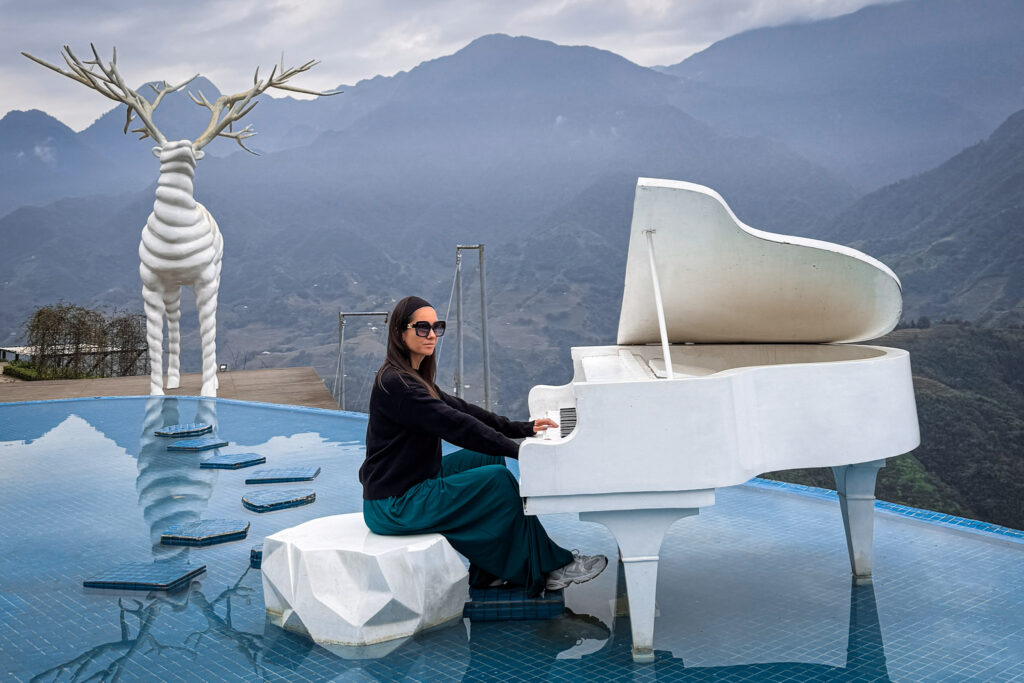
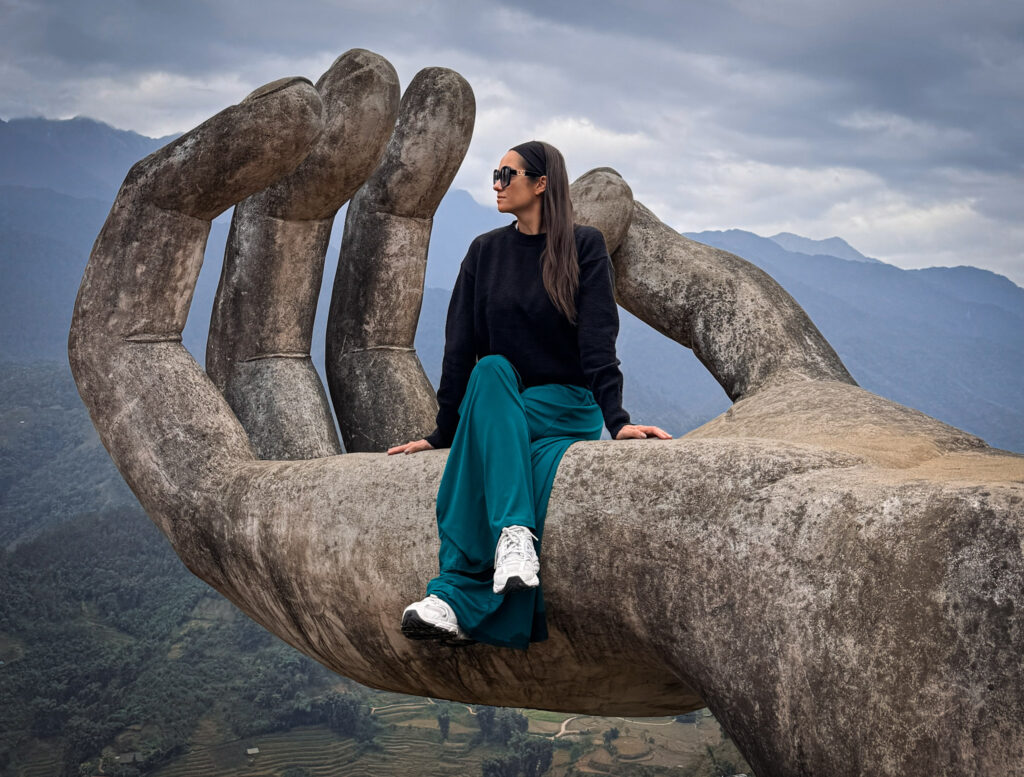
The Giant Golden Hand perched above the valley with rice terraces stretching endlessly behind it — tick. The Spirit of Sapa wooden goddess sculpture rising dramatically above a mirror-like infinity pool — tick. The white grand piano sitting in the middle of the infinity lake with misty mountains as the backdrop — absolutely, unquestionably tick.
I went in expecting a quick photo stop. I stayed for two hours. No regrets whatsoever.
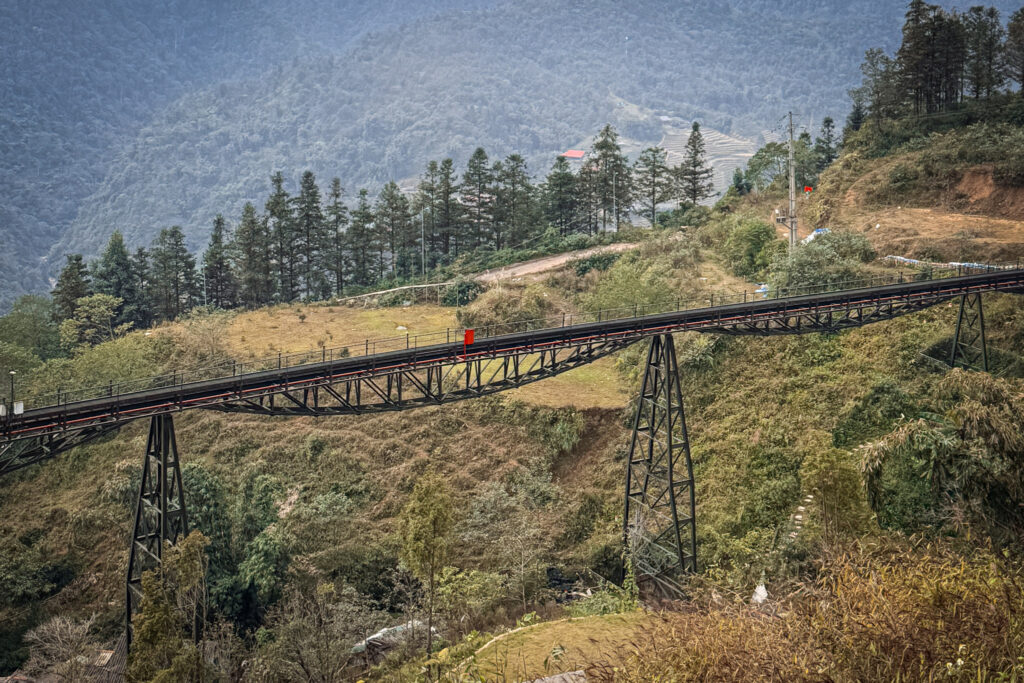
After that, I had a breakfast with a view. And not just any view — a misty mountain valley, a dramatic iron bridge cutting across the hillside, pine trees disappearing into the clouds. The kind of breakfast scenery that makes you question every meal you’ve ever eaten at home.
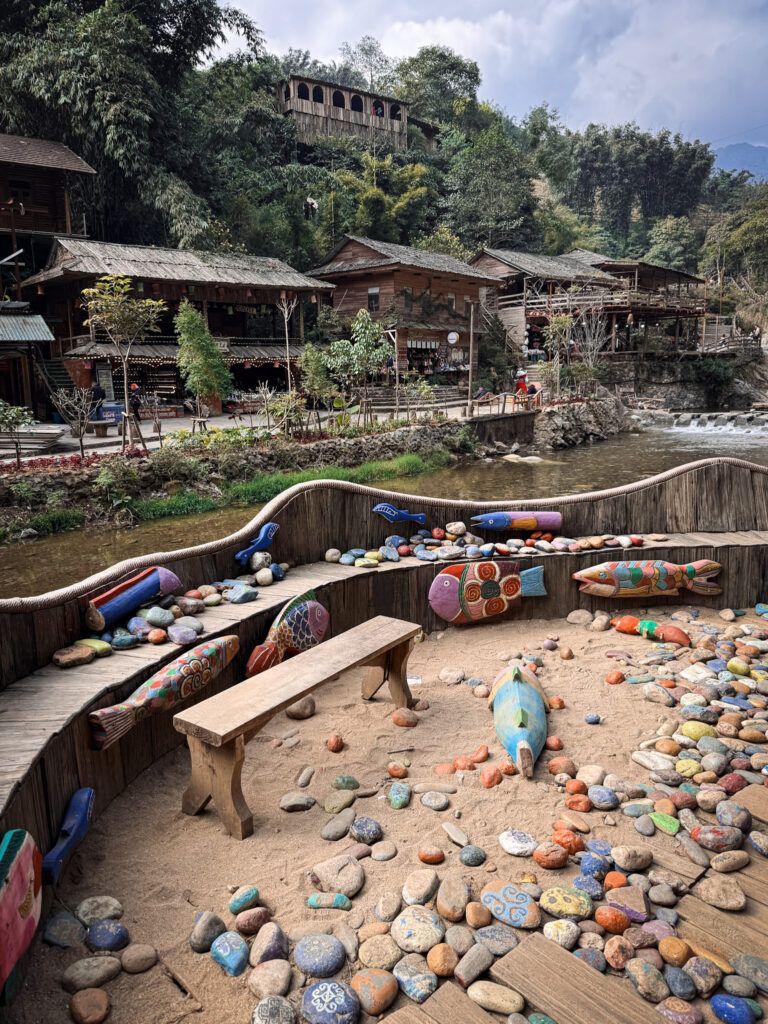
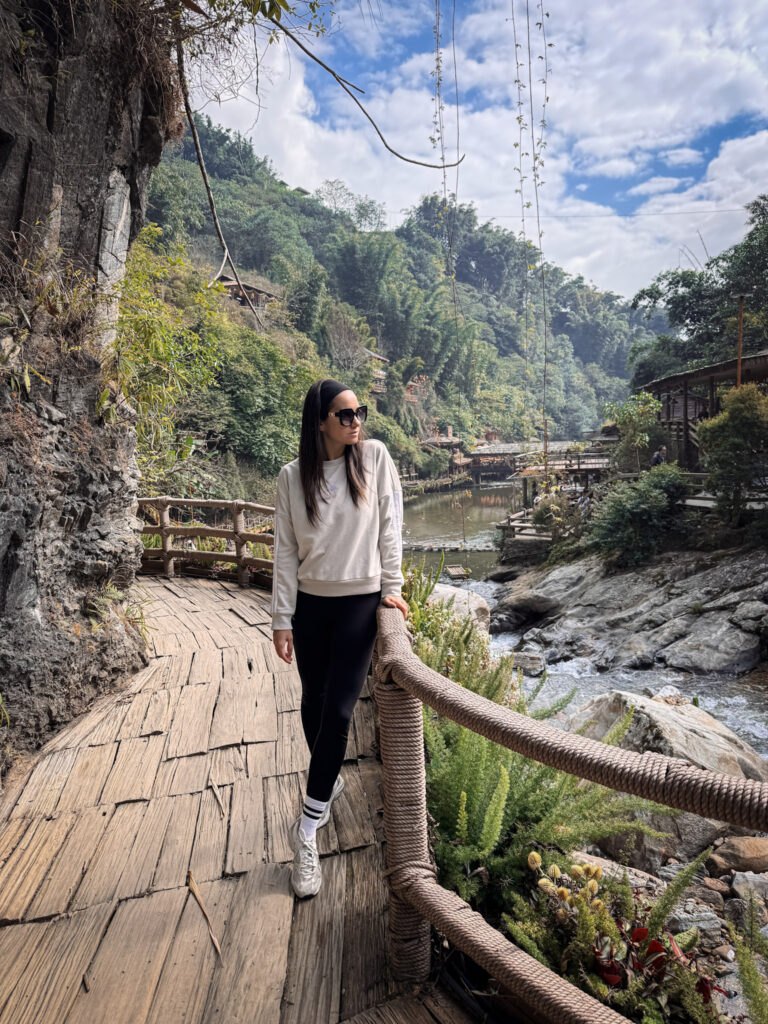
But the real surprise of the day was Cat Cat Village. Nothing fully prepares you for it. You walk down into the valley and suddenly the noise of Sapa town disappears, replaced by rushing water, birdsong, and the kind of quiet that makes you slow down without even realising it. The village belongs to the Black H’Mong people, and walking through it — past bamboo water wheels, terraced fields, traditional wooden houses, and a proper waterfall — feels like stepping into a completely different world from the mountain town just 2.5 kilometres above.
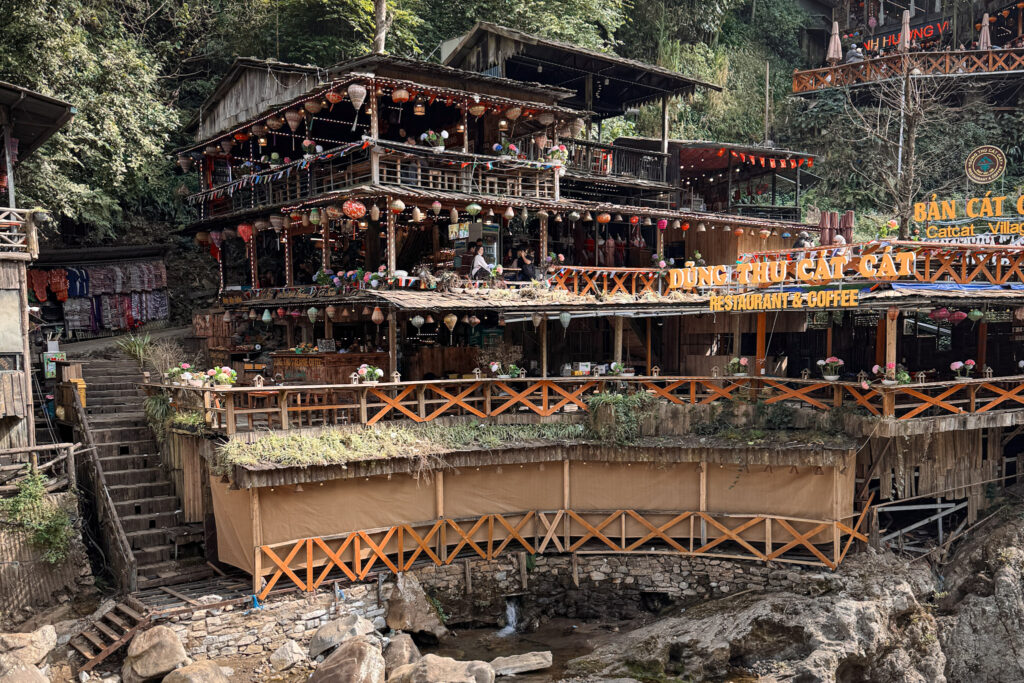
Cat Cat is a traditional H’mong minority village tumbling down the hillside, and it feels genuinely magical — like someone took a fairytale, added a waterfall, and forgot to tell anyone. Wooden bridges cross over rushing streams, traditional stilt houses peek through tropical greenery, old water wheels turn slowly by the river, and flowers grow in every corner like they can’t help themselves.
And then there are the people. Young H’mong women in stunning hand-embroidered traditional costumes — deep blues, rich reds, intricate silver jewellery — having professional photoshoots against the waterfall backdrop. It sounds like it should feel staged. It absolutely didn’t. It felt like walking onto a movie set where everyone forgot to turn the cameras on.

I kept stopping, looking around, and thinking — is this place actually real? Apparently it is. And it’s one of the most beautiful things I saw in all of Vietnam.
Useful Information: Entrance fee is 150,000 VND (~$6 USD) per adult, cash only — no card payments accepted at the ticket gate. Open daily from around 6am to 9pm. The walk down from Sapa town takes about 30 to 45 minutes downhill — beautiful and easy going down, but a steep climb back up. Most visitors walk down and take a motorbike taxi back up (around 50,000–70,000 VND one way) rather than doing the return climb on tired legs.

Jet Lag Jelly Tip: And bring cash — there's nothing in the village that takes cards.
Day 4: Sapa — Rice Terraces, Real Lives & The Best €16 I’ve Ever Spent
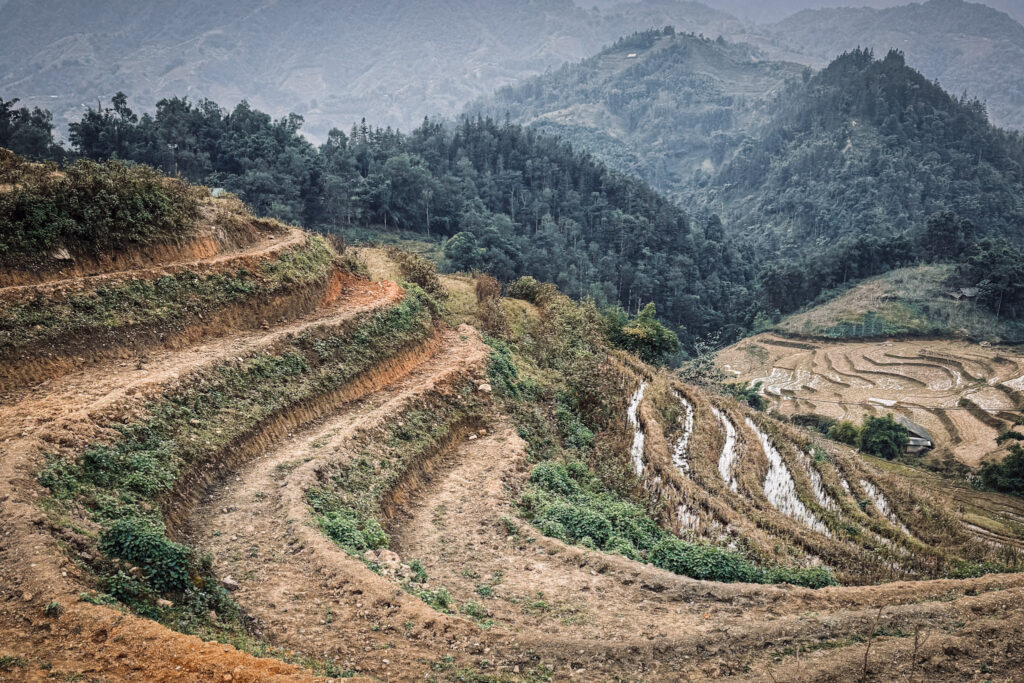
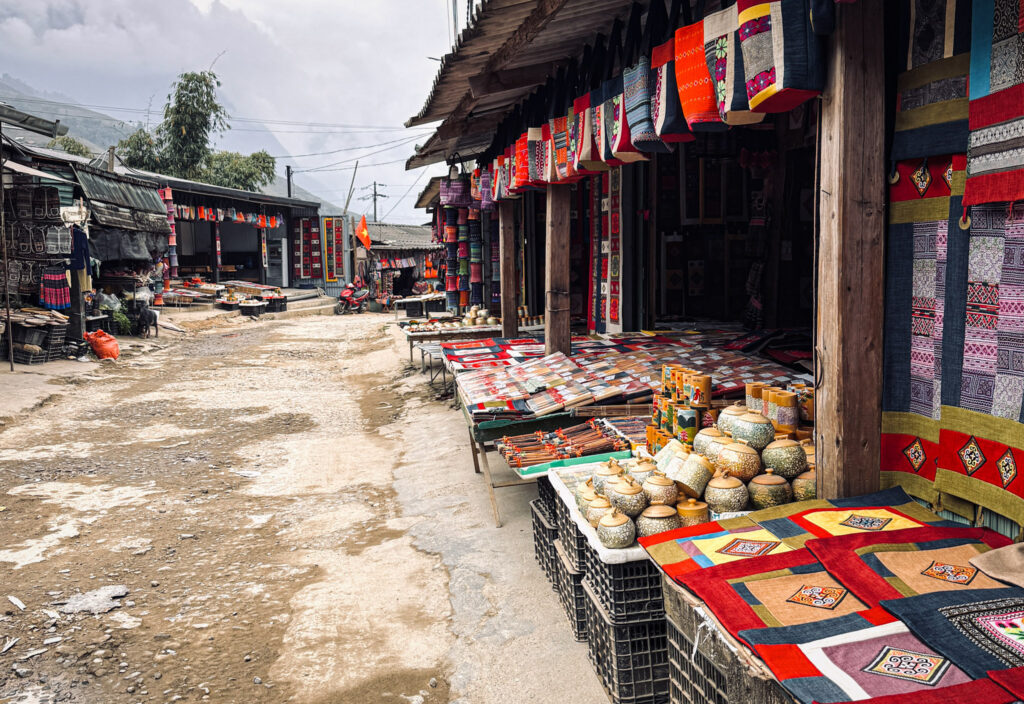
The day started with a trek through the Muong Hoa Valley — route Sapa → Y Linh Ho → Lao Chai → Ta Van — guided by local Hmong sisters who grew up in these very mountains. And that detail matters. Because walking through rice terraces with someone who actually calls this place home is a completely different experience from following a flag on a stick through a tourist route.
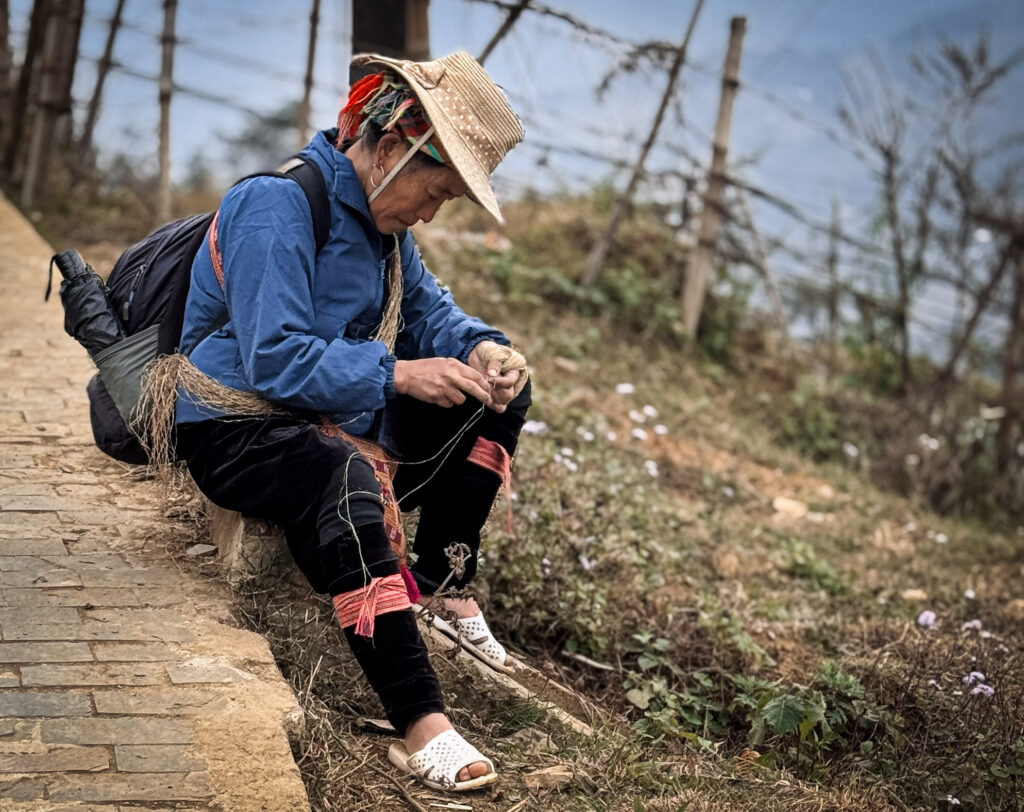
We met a local woman who was doing hand-spinning thread — a traditional Hmong craft where raw plant fibers are twisted and spun into thread by hand, which is then used to weave or embroider their famous traditional textiles and clothing.
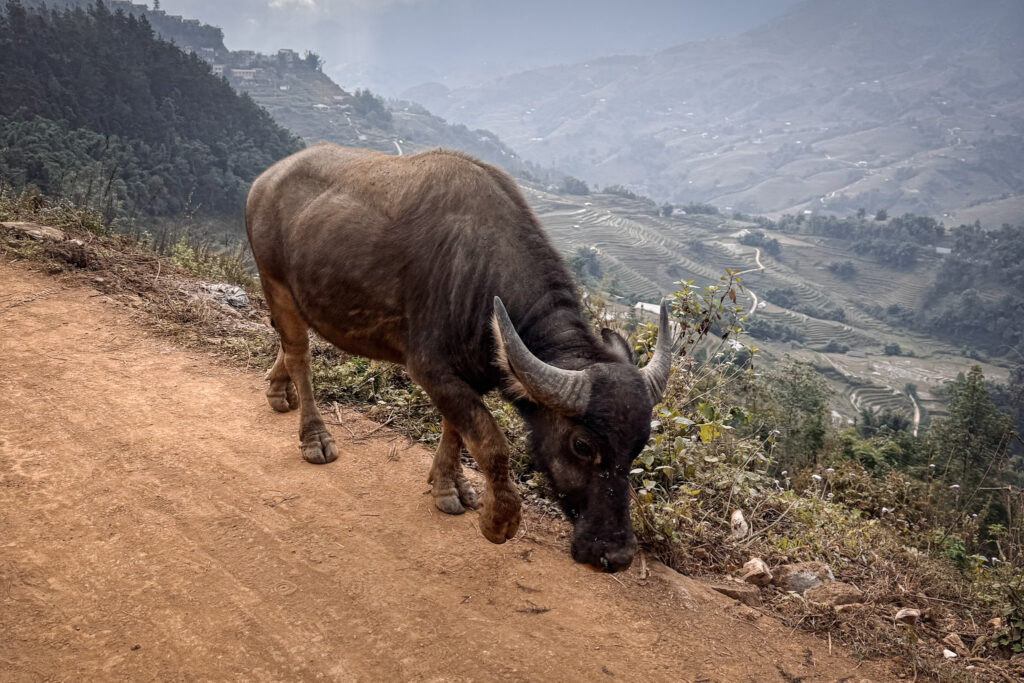
The landscape was breathtaking in that quiet, unhurried way that big famous sights rarely are. Endless terraced rice fields cascading down the hillside, buffalo wandering along the path, small wooden villages appearing through the mist. The kind of scenery that makes you put your phone down and just walk.
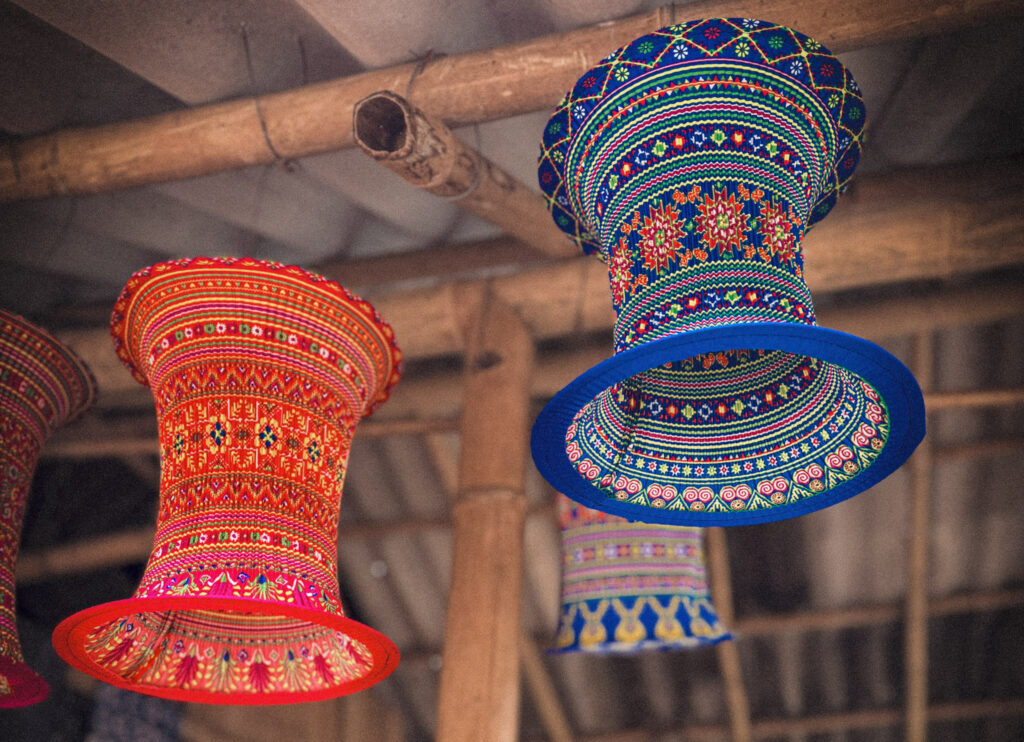
Y Linh Ho and Lao Chai — two of the oldest Hmong communities in the area — offered a glimpse into daily mountain life that felt genuinely authentic. Lunch at a local restaurant in Lao Chai was simple, delicious, and exactly what tired trekking legs needed.
Local woman is doing traditional Hmong batik — a fabric dyeing technique where she draws intricate patterns onto cloth using hot wax (you can see the wax tool and the bowl with hot coals underneath to keep it melted). The fabric is then dyed, and the wax is removed to reveal the beautiful white patterns.
There is a finished batik fabrics hanging behind her — those deep blue and white patterned textiles are a signature of Hmong craftsmanship and have been made this way for centuries.
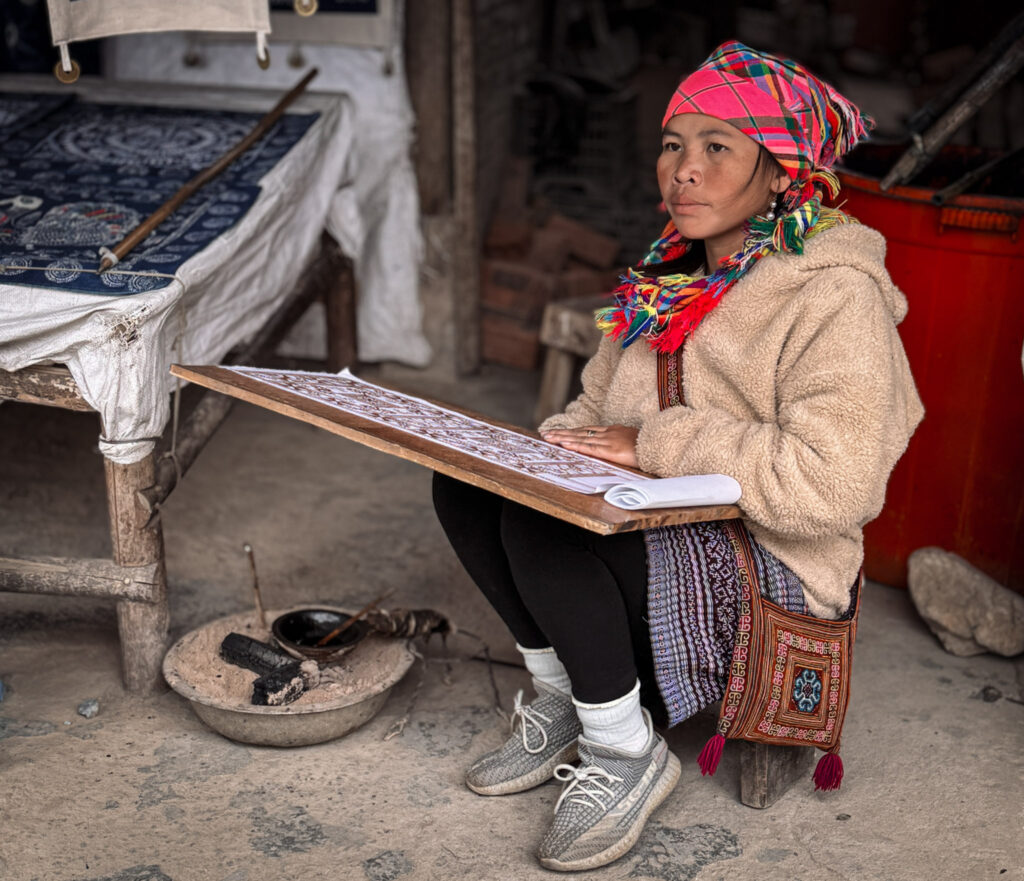
It’s a dying art in many places, which makes seeing it done by hand in a real village even more special.
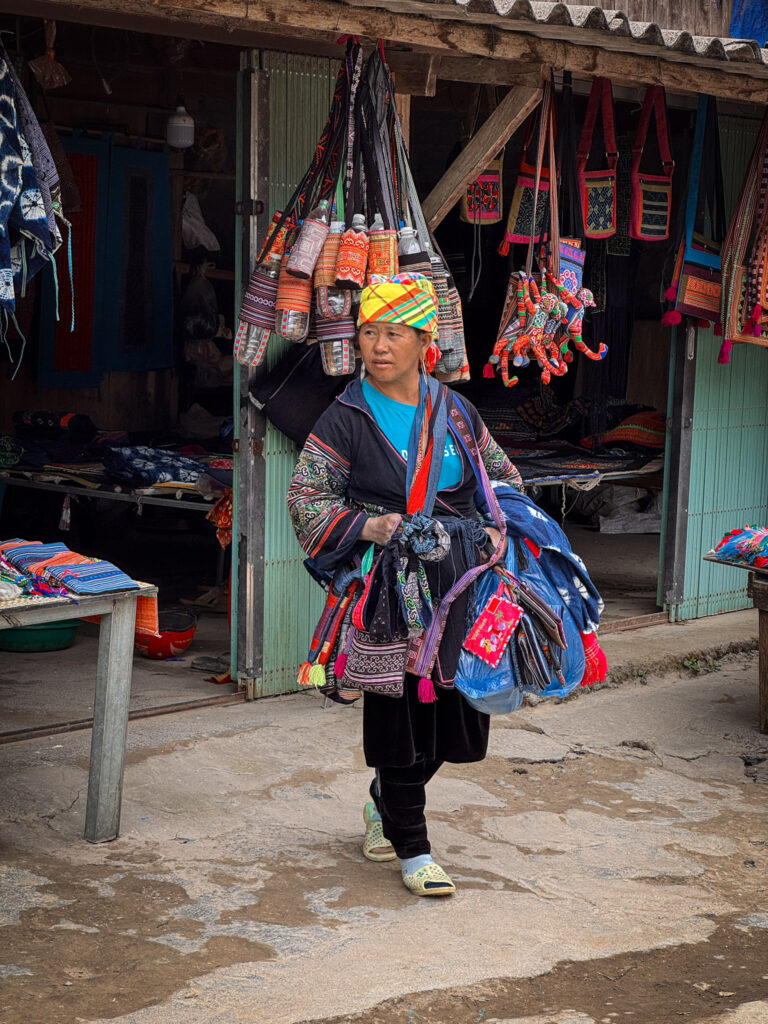
The final stop was Ta Van Village, home of the Dzay people — a different ethnic minority group with their own distinct culture, language and traditions. In the right season you can even see rice planting or harvesting happening in real time.
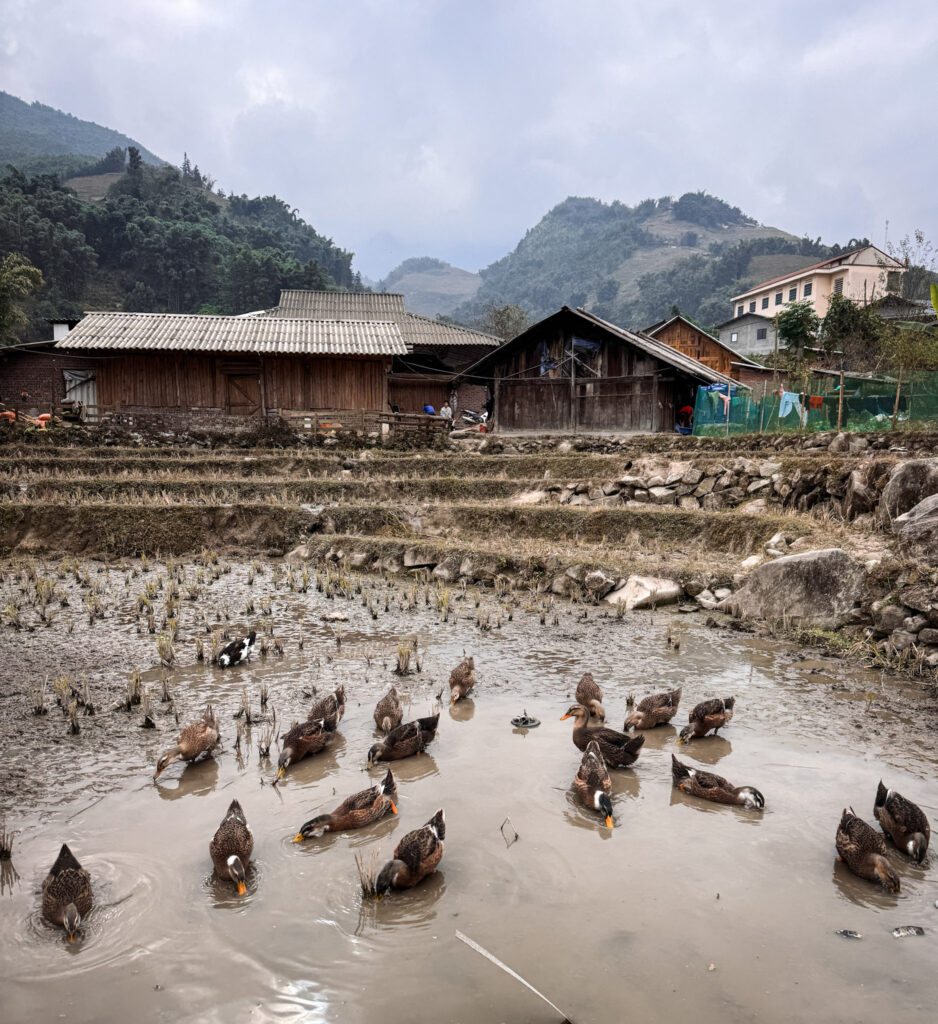
One of the most humbling moments of the entire trip came when we were invited inside a local family home in Tan Van Village.
The living room was a simple stone-walled space where the family sat together on the floor around an open fire. No bathroom — just an outdoor toilet. The kitchen was basic but functional, pots and red buckets and pans that had clearly seen a lifetime of meals. A few family photos on a shelf. Some personal belongings scattered around. Not much else. And yet it felt completely like a home. Warm, lived-in, and full of quiet dignity.
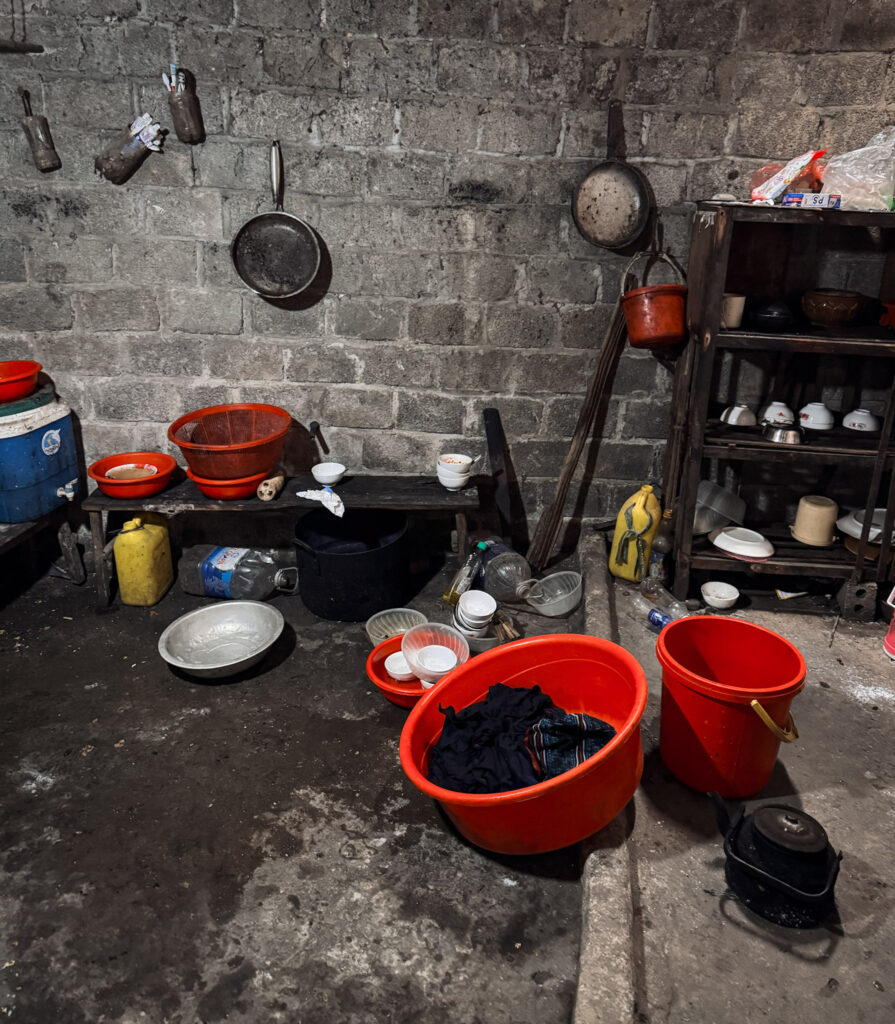
Standing there, it was impossible not to feel the contrast — we spend so much time worrying about things that genuinely don’t matter. This family had almost nothing by modern standards and seemed to need nothing more. It felt like stepping back 100 years, not in a sad way, but in a way that makes you stop and recalibrate.
Some travel experiences are beautiful. Some are delicious. And some just quietly rearrange your priorities. This was one of the latter.
Another thing that stayed with me most wasn’t the scenery. It was the guides themselves. Three Hmong sisters running their own tour business, supporting local women, helping children access education, and sharing their life stories along the way — all for €16. Booking this tour doesn’t just get you a great day out. It directly supports women who are quietly changing things in their community. That’s worth every cent and then some.
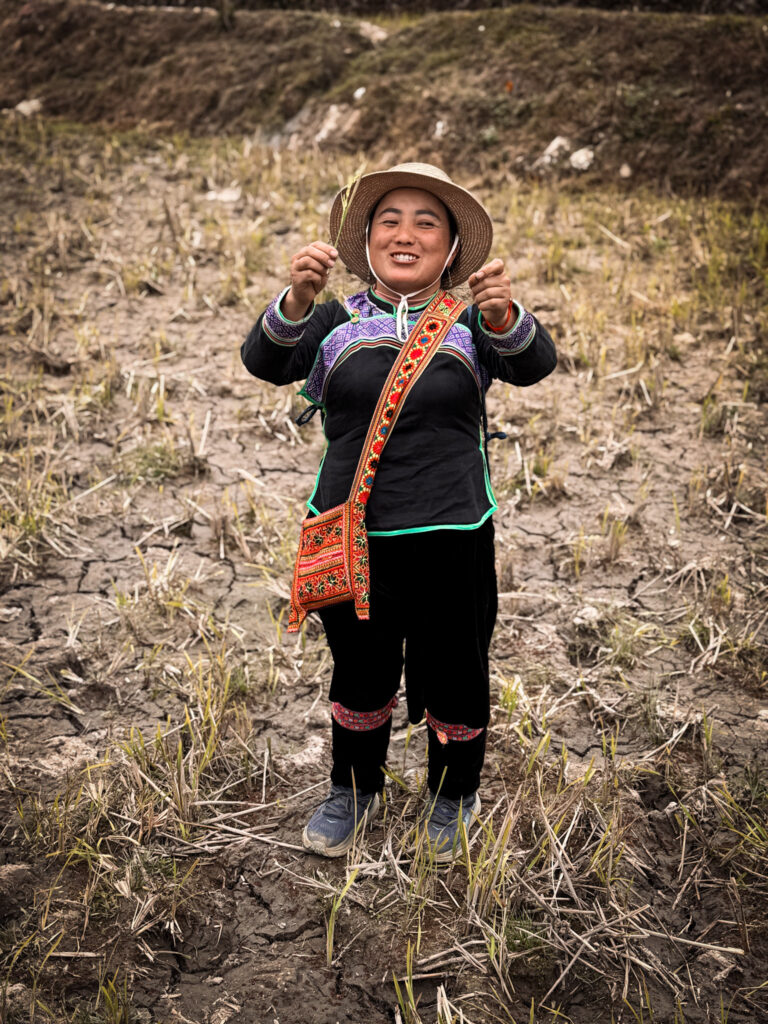
Jet Lag Jelly Tip: Book the Hmong Sisters trek on GetYourGuide — it's one of the most meaningful and affordable tours I've done anywhere in the world. Around €16, incredible scenery, real stories, and you're supporting local women directly. Absolute no-brainer.
Day 5: Sapa — Pho, Clouds & Walking on Glass
The last day in Sapa started slow and simple — exactly what tired trekking legs needed.
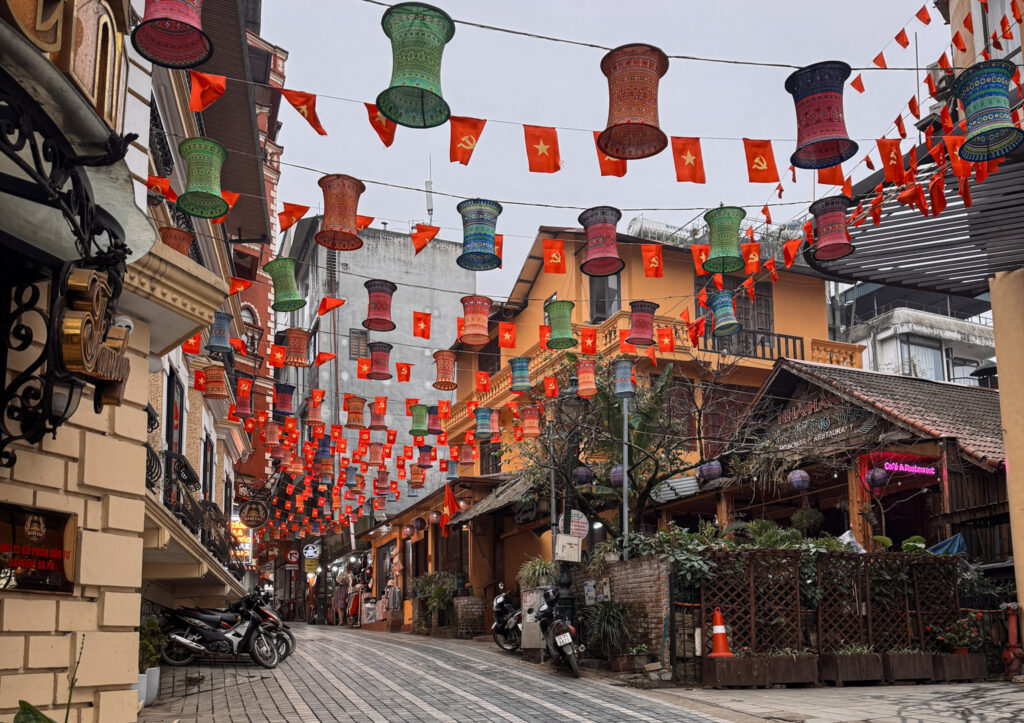
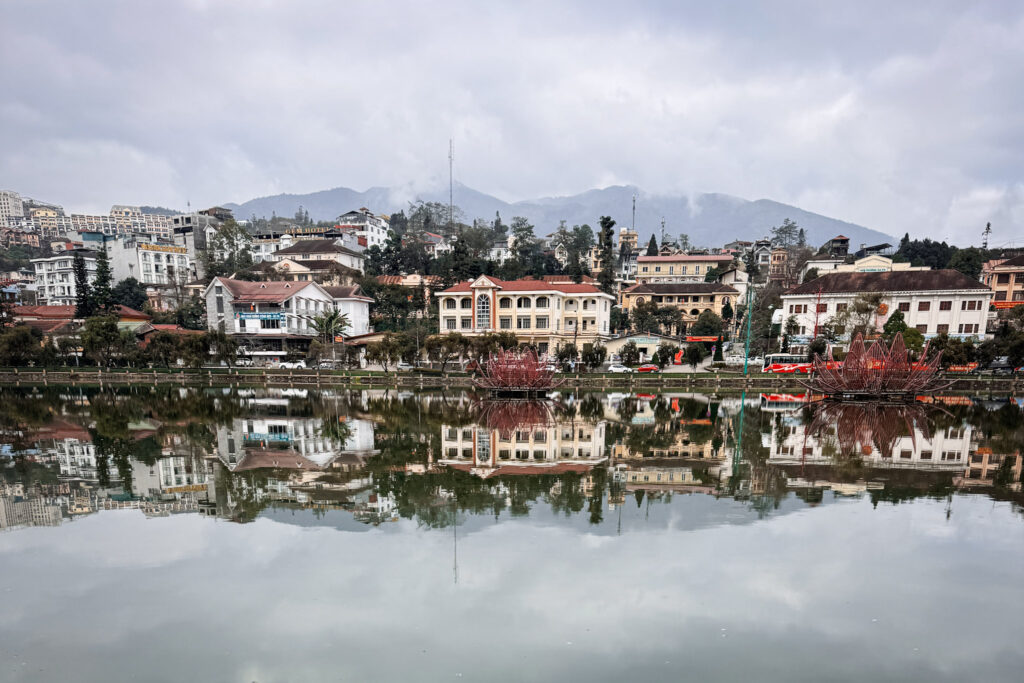
A morning walk around Sapa town, soaking up the atmosphere one last time. And of course, trying the local pho. Verdict? Look, it was fine. Warm, comforting, and exactly what you need after days of mountain air. Was it the most flavourful bowl of soup I’ve ever had? Honestly, no. But sitting there, watching Sapa wake up around me, it tasted pretty perfect anyway. Sometimes it’s less about the food and more about the moment.
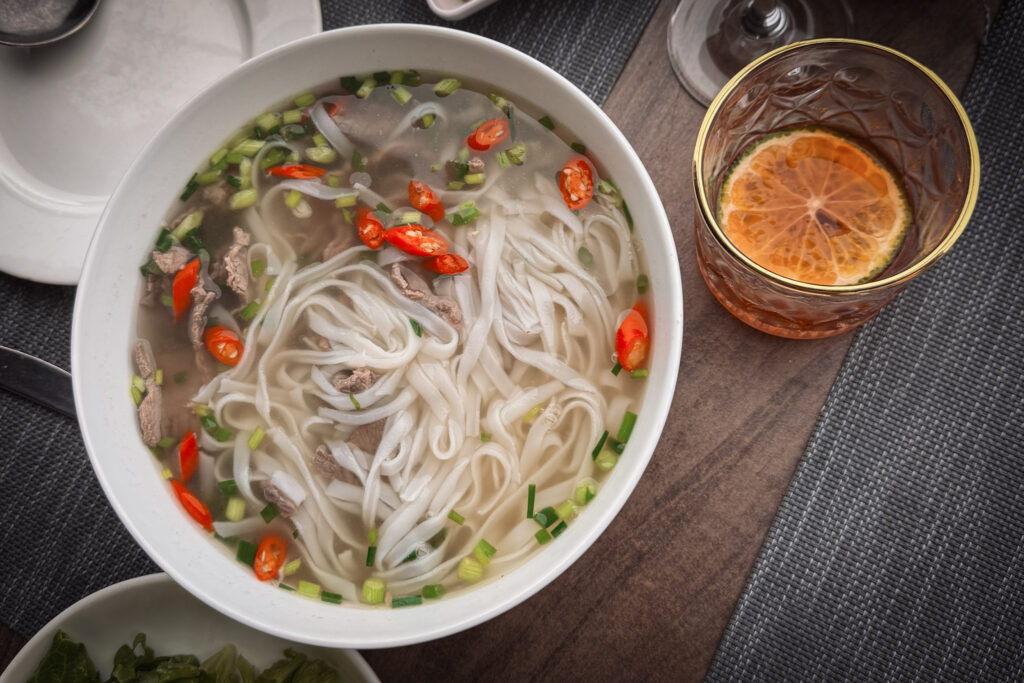
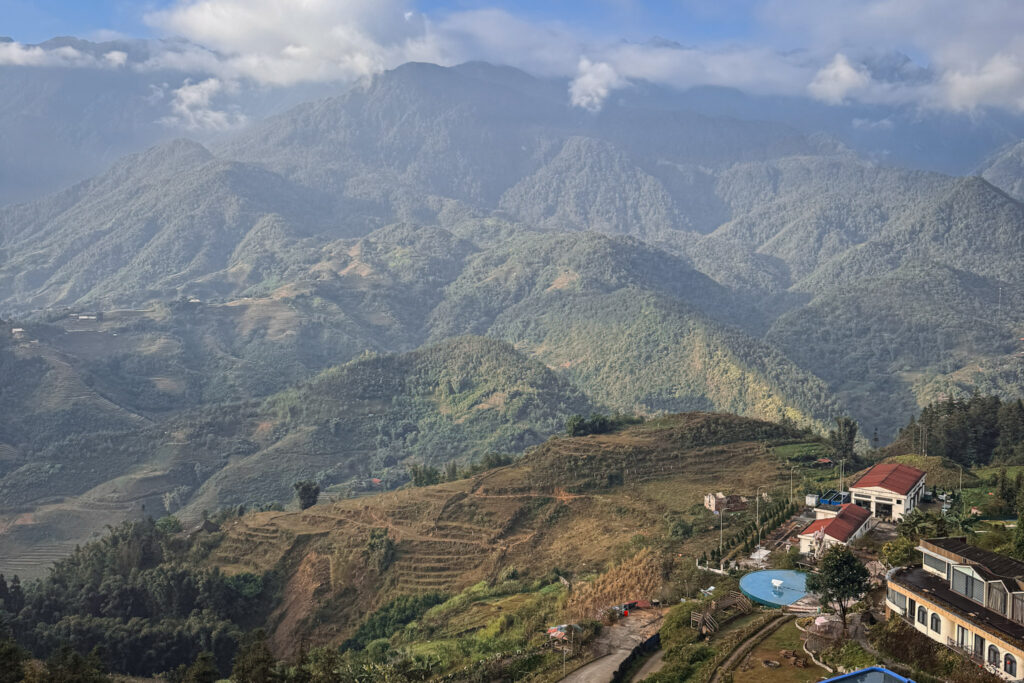
Then things got more dramatic.
Getting to the Cloud Dragon Glass Bridge involves a taxi ride that deserves its own mention. The mountain road twists and turns in ways that make you question every life decision that led you here — hairpin curves, steep drops on both sides, and a driver who clearly does this every day and finds it completely unremarkable. About 18km from Sapa town, 30-40 minutes of pure mountain road adventure. By the time you arrive, you’ve already had enough adrenaline for one day. And then you see the rainbow staircase going up. And you realize you’re just getting started.
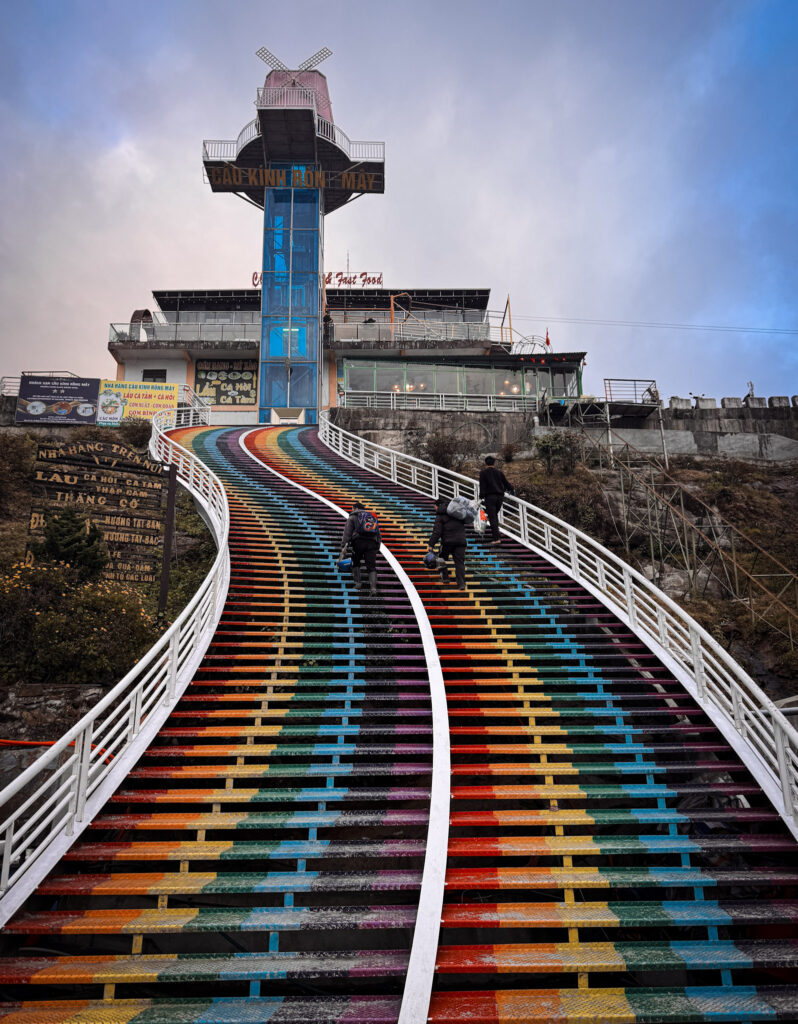
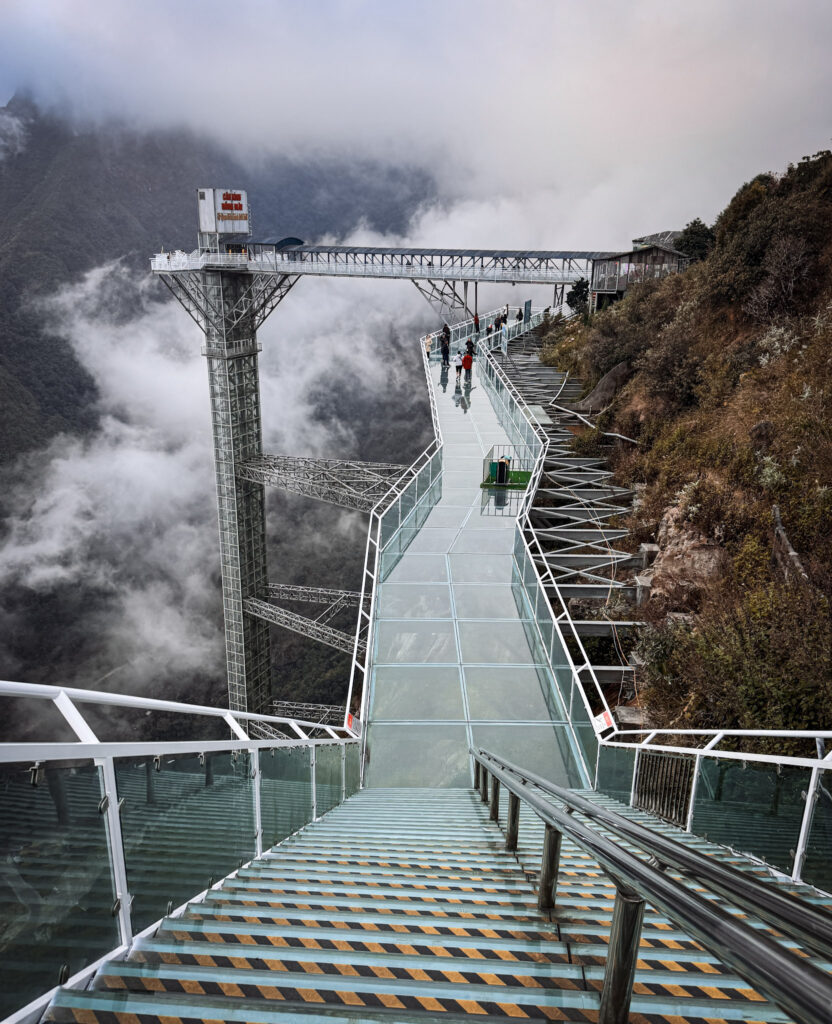
Cầu Kính Rồng Mây — the Cloud Dragon Glass Bridge starts with a rainbow staircase. Which should be cheerful and welcoming. It is not. Because at the top of that rainbow staircase you realize exactly how high up you are and exactly what you’ve signed up for.
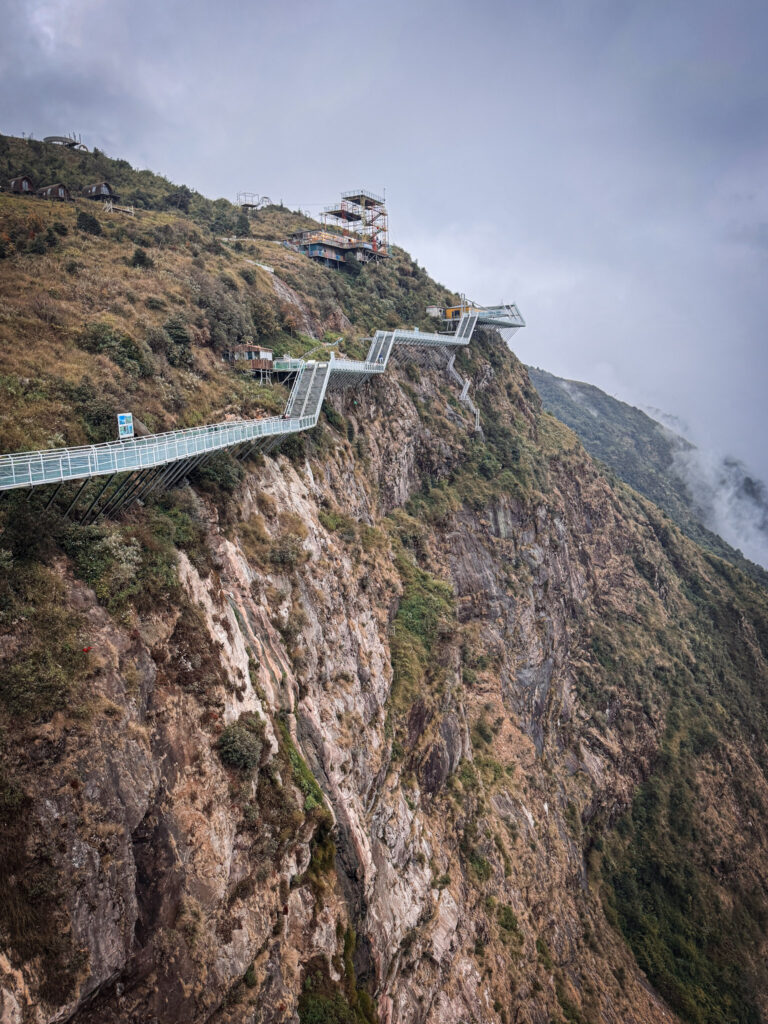
The glass walkway is bolted directly onto a sheer cliff face at 2,200 meters above sea level — the highest glass bridge in all of Southeast Asia — disappearing into the clouds on both sides. The entire structure extends 60 meters out from the cliff face, made of reinforced glass giving a crystal-clear view of the abyss below. From the outside it looks completely unhinged. From the inside it looks… also completely unhinged, just with a better view.
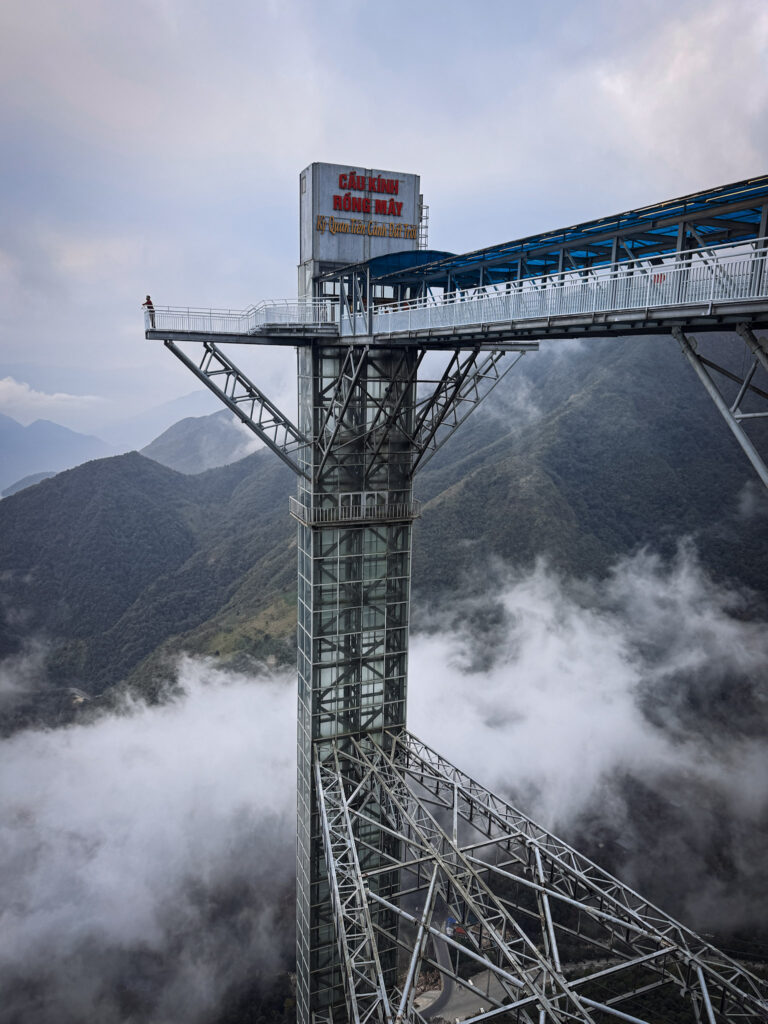
Was I scared? Not particularly. Was it absolutely, ridiculously cold up there with wind cutting through every layer I was wearing? Yes. Absolutely yes. The clouds weren’t just around the bridge — they were on the bridge. Walking through actual clouds on a glass floor above a mountain valley at 2,200 meters is one of those experiences that’s genuinely hard to explain to someone who hasn’t done it. So I won’t try. Just go.
Useful Information: Entry is 500,000 VND (~$19 USD) per adult, which includes the round-trip glass elevator up to the bridge. Open daily 7:30am to 5pm. Cash and card both accepted at the entrance. Book tickets in advance through Klook to save 20,000–50,000 VND per ticket and skip the queue. Getting there: taxi from Sapa town costs around 200,000–300,000 VND one way for a group of 3–4, or around 100,000–200,000 VND by motorbike taxi per person.

Jet Lag Jelly Tip: Take a taxi from Sapa town — the road has serious curves and steep drops so it's not the time to be navigating yourself. You can book tickets in advance through GetYourGuide to save on the entrance fee and skip the queue. Bring a very warm jacket too — even if it's warm in Sapa town, at 2,200 meters it's a completely different story. And wear it before you get on the bridge, not while trying to put it on in 100km/h wind. Ask me how I know.
As the day wound down, it was time to say goodbye to Sapa — and hello to another overnight bus back to Hanoi. Same experience as before: comfortable enough, scenic enough in theory (although significantly less scenic at night), and once again absolutely zero sleep because apparently my body has a strict “own bed only” policy that no amount of mountain air can override. Some things don’t change.
Sapa, though? Sapa changes you a little. In the best possible way.
Day 6: Ha Long Bay — Five Stars, One Night & Kayaking Through Karst Mountains

After the chaos of Hanoi and the mountains of Sapa, Ha Long Bay arrived like a reward. But first — the journey.
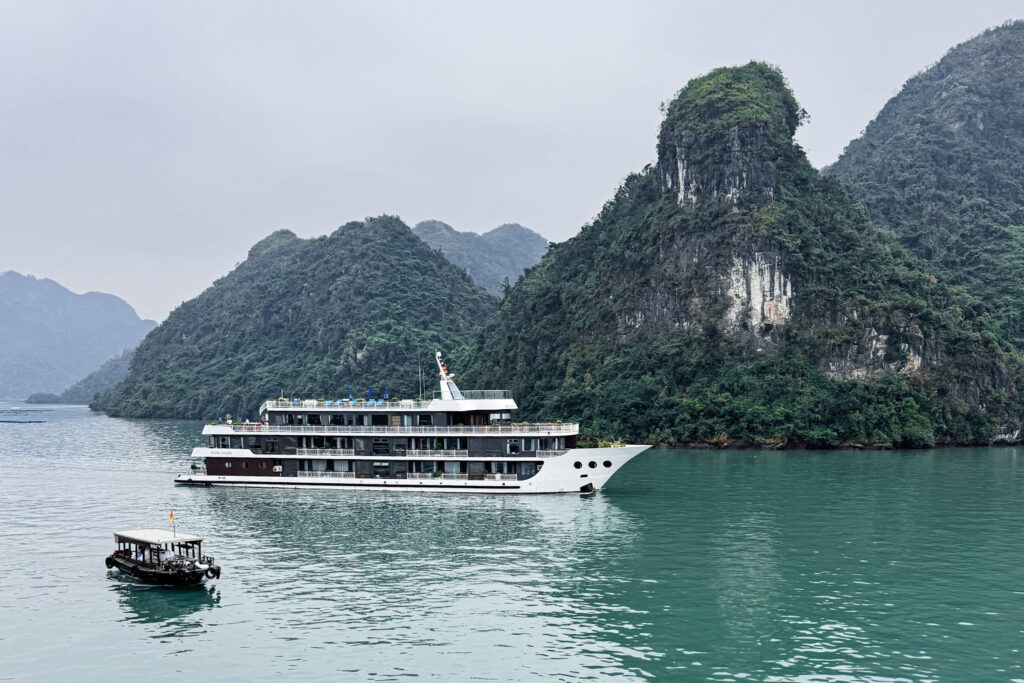
The organized tour picked us up early in Hanoi and the bus wound its way through the Vietnamese countryside for about 3-4 hours before the harbour finally came into view. From there, a smaller boat transferred us out to the cruise ship — and that short ride alone already felt like entering another world, with the first limestone mountains starting to appear on the horizon.

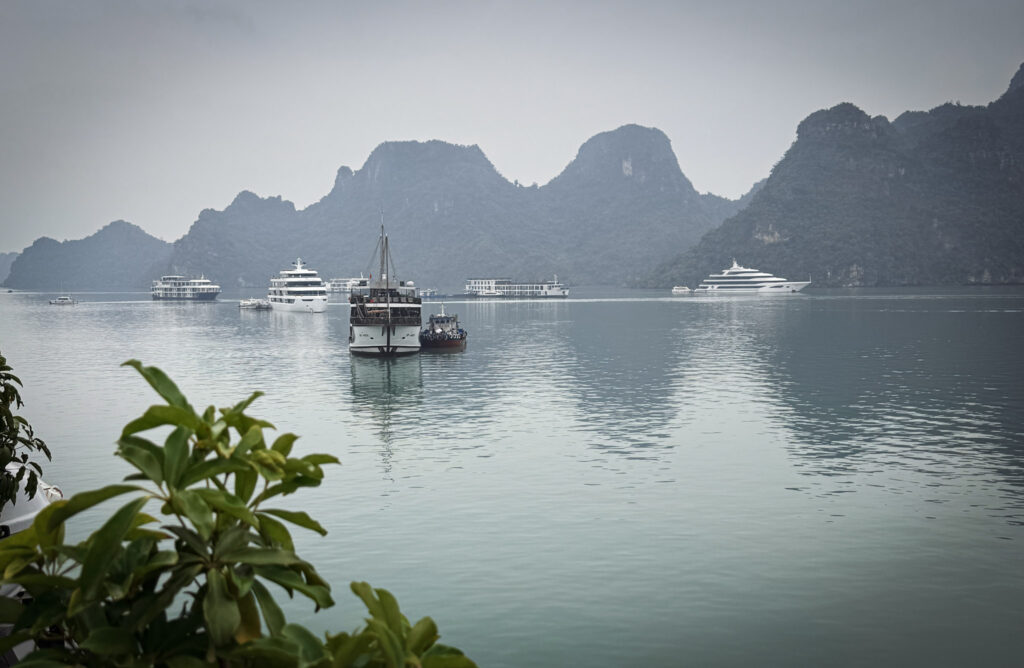
We arrived just in time for lunch. And not just any lunch — a full buffet spread that set the tone for everything that followed. Fresh shrimp, fish with bamboo, mountains of tropical fruit, and more dishes than I could work my way through in one sitting. Which didn’t stop me from trying. Five stars promised, five stars delivered — starting from the very first meal.
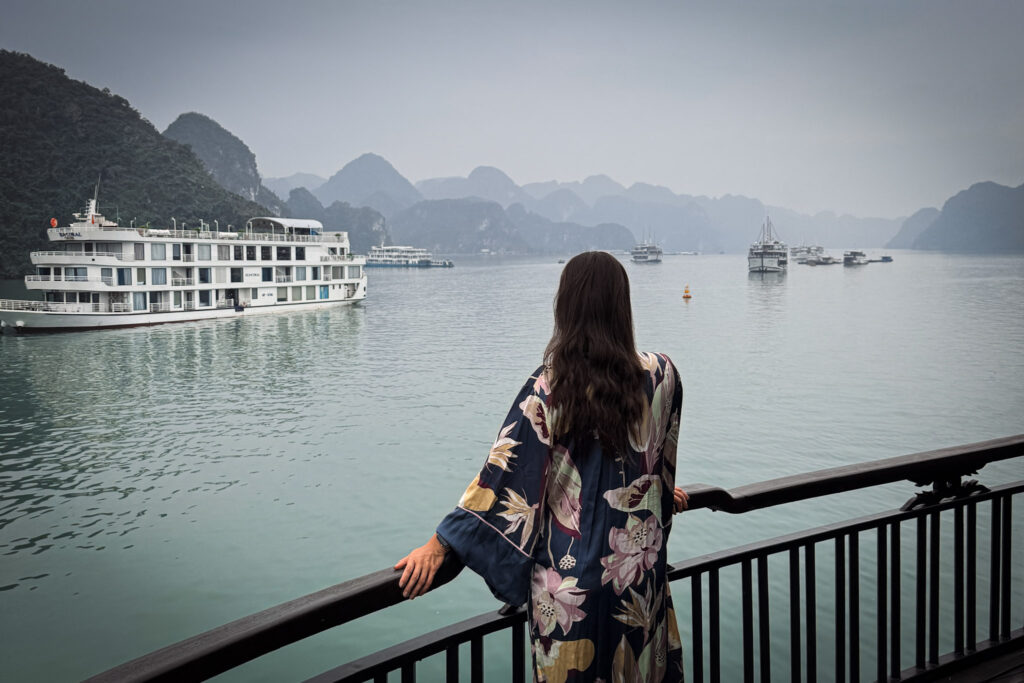
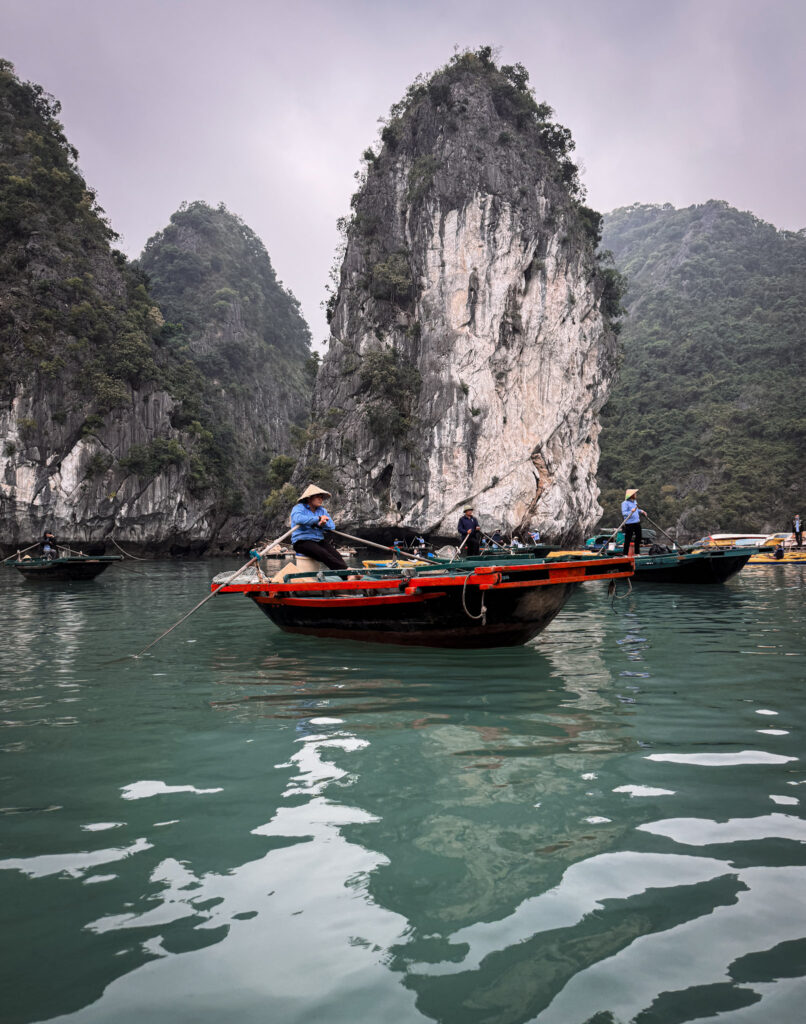
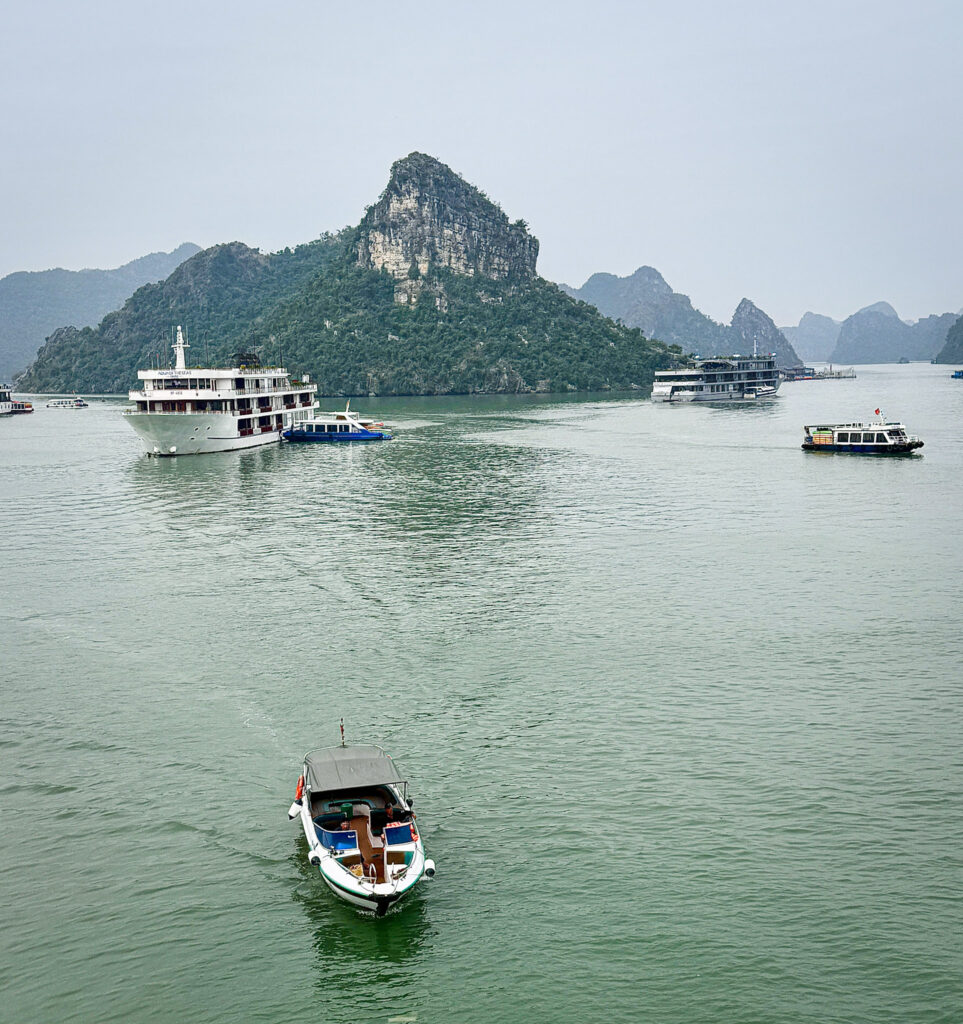
Within an hour of settling in, the landscape started doing something completely unreasonable. Thousands of limestone karst mountains rising dramatically from the water in every direction — some cloaked in mist, some emerging from low cloud, all of them looking like they were lifted straight from a fantasy novel. December means the colours aren’t the vivid turquoise blue you see in summer photos — the sky is softer, the water greener, the mist thicker. And honestly? It made everything feel even more mysterious and magical.
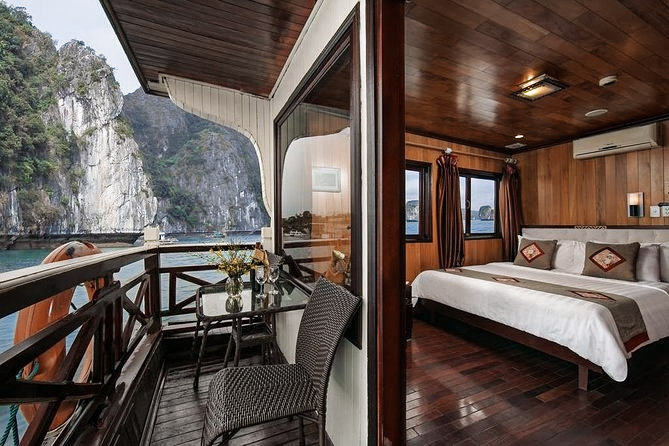
The cabin was pure luxury — private balcony with ocean views, bathtub, all meals included, and the kind of service that makes you briefly forget you’ve been living out of a backpack for days. The food deserves its own paragraph. Actually, it deserves its own blog post. Every meal was outstanding — fresh seafood, Vietnamese classics, beautifully presented and genuinely delicious. Five stars on the tin, five stars in reality. Not always the case. Very much the case here.
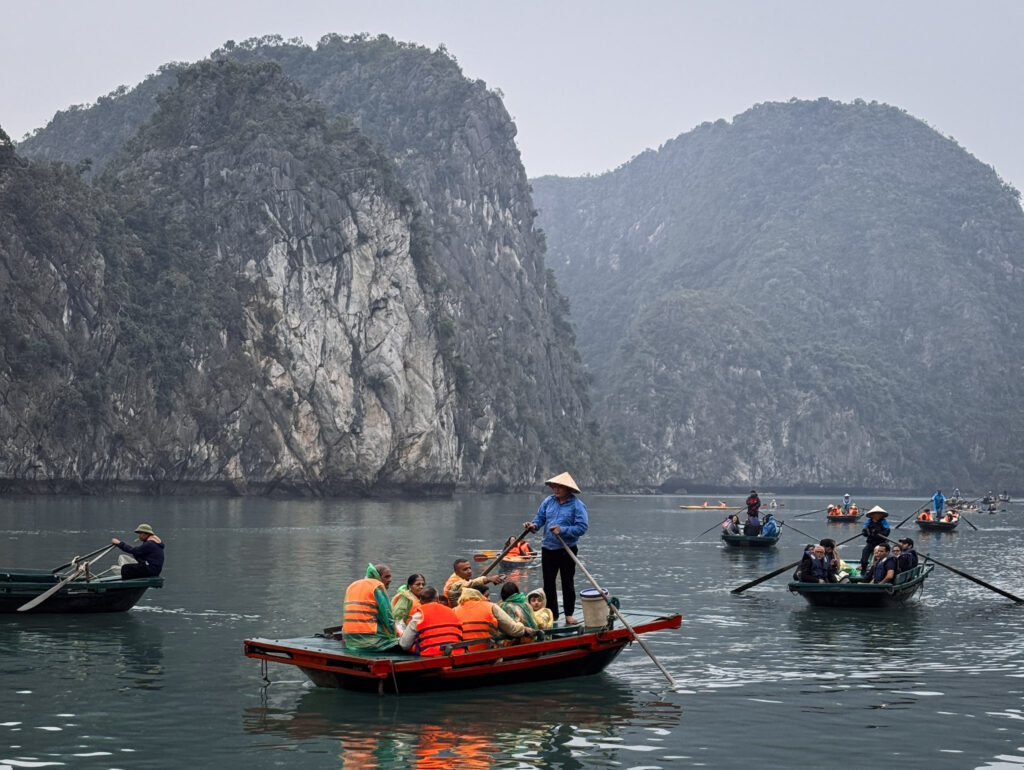
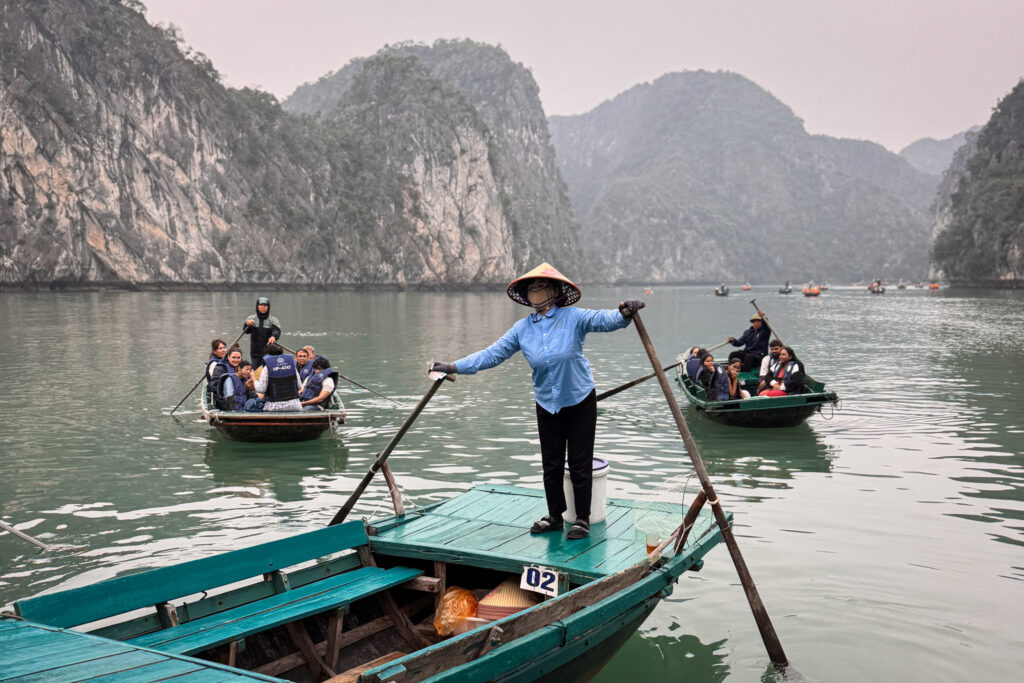
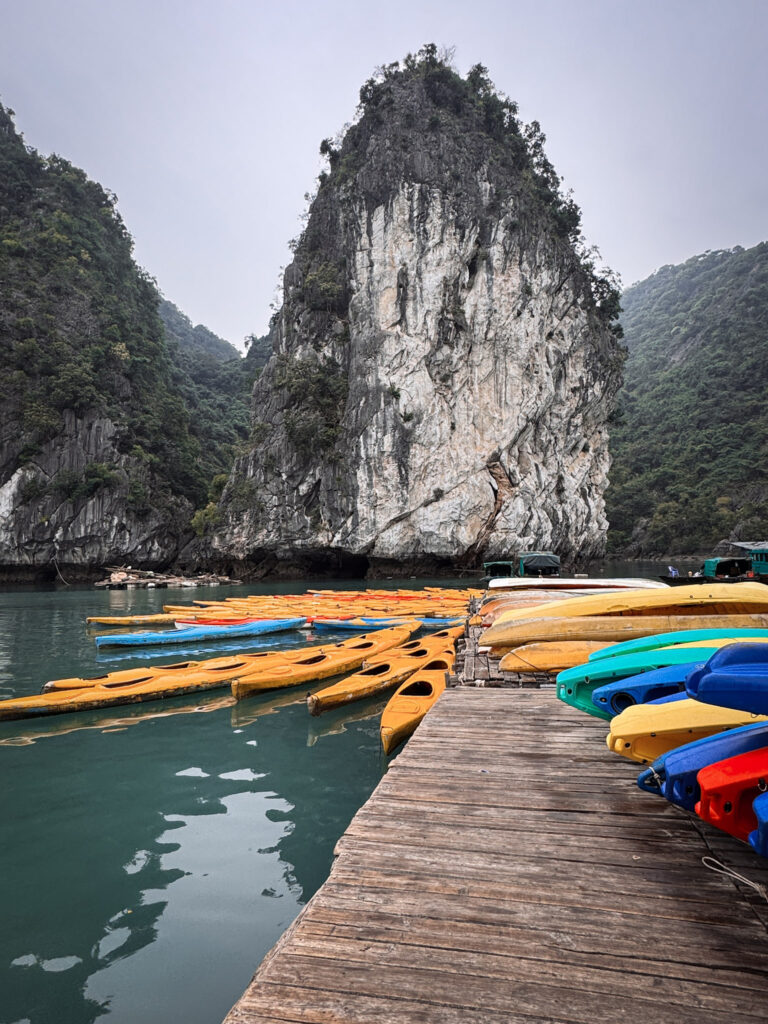
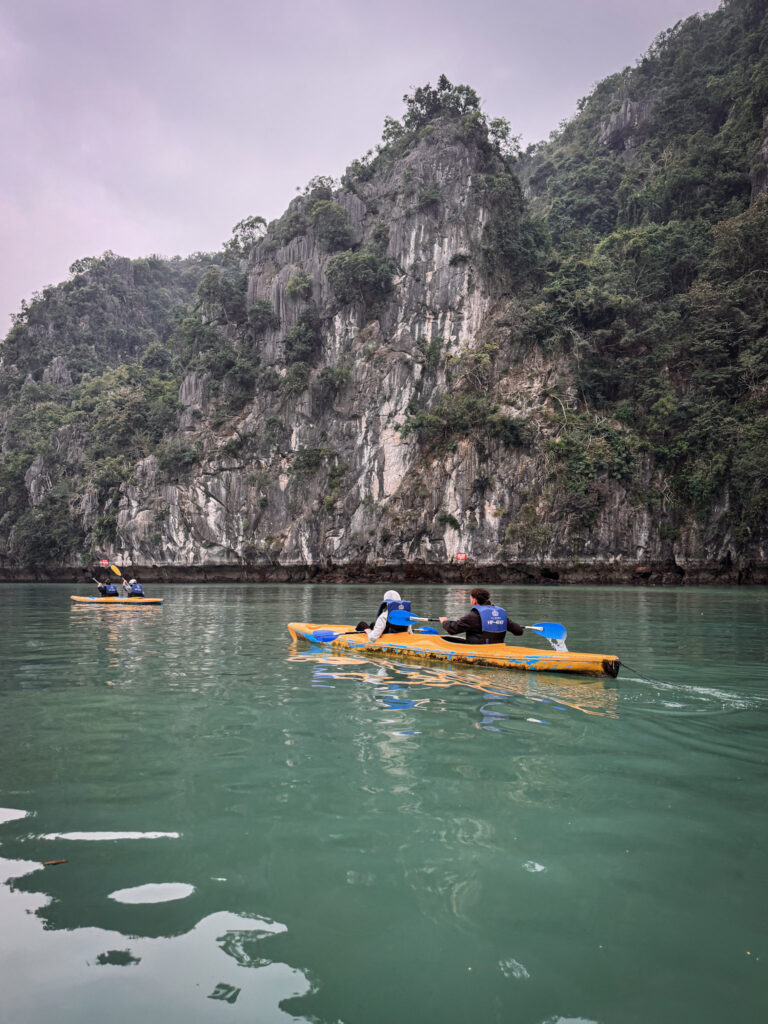
The afternoon was spent kayaking through the karst mountains — paddling through narrow passages between towering limestone cliffs, under natural arches, and into hidden lagoons. One of those activities that sounds nice in a brochure and turns out to be even better in real life.
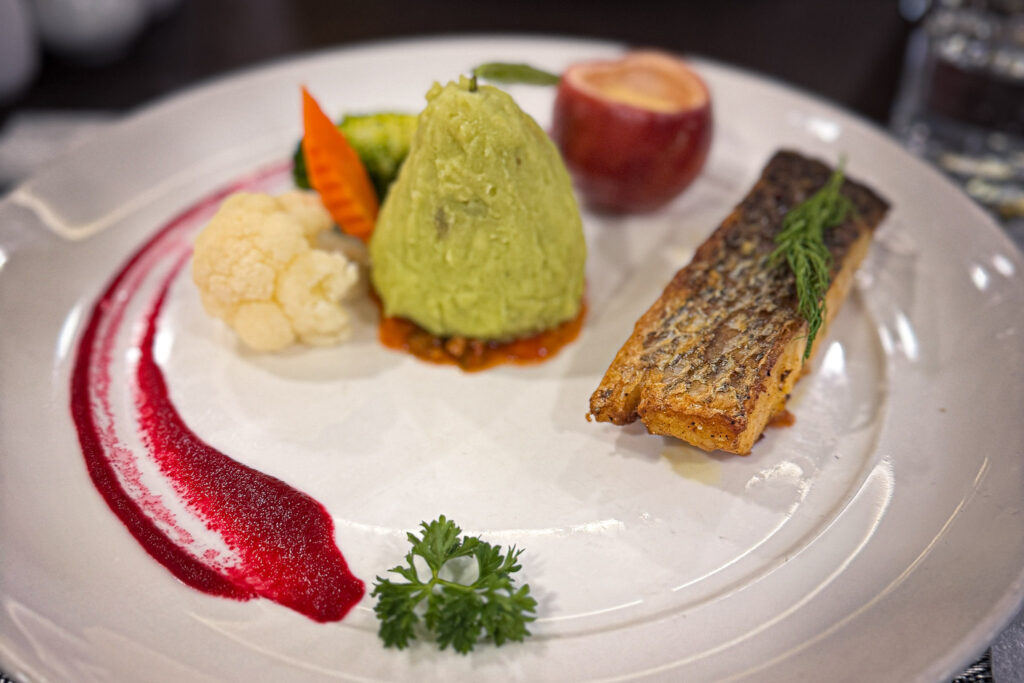
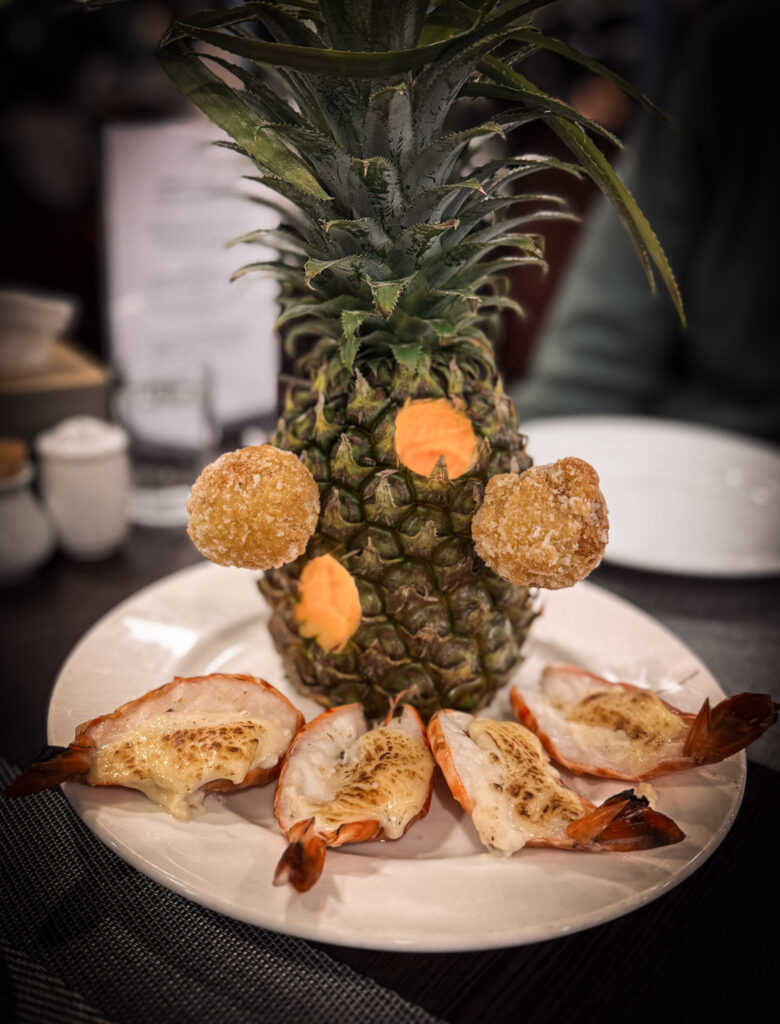
But the highlight of the day? Dinner. The set dinner on board was genuinely one of the best meals of the entire Vietnam trip — and that’s saying something. Pan-seared fish with cauliflower mousse and beetroot sauce plated like something from a Michelin-starred restaurant. Grilled shrimp with cheese served around a whole pineapple with crispy coconut balls. Beautiful, creative, and absolutely delicious. At some point I stopped taking photos and just ate. That’s always the sign of a truly great meal.
As the sun went down, it was time for squid fishing. Armed with a line, a light, and entirely too much confidence, I spent a very committed amount of time attempting to catch something. The squid, it turns out, were not interested. Not a single one. The bay is beautiful, the experience is fun, and the squid are unbothered. Some things are just not meant to be.
Useful Information: Ha Long Bay cruises are almost always booked as package tours from Hanoi — the organized pickup, bus transfer, and onboard accommodation are all included. You can browse all available 5-star cruise options, from 1-night to 3-night itineraries, on the GetYourGuide Ha Long Bay collective page — filter by duration and star rating to find the one that fits your schedule and budget.

Jet Lag Jelly Tip: Book at least a 2-night cruise if your schedule allows — 1 night is enough to get a taste but not enough to fully sink into the experience. The second morning, when the mist lifts and the bay is completely quiet, is worth every extra penny.
Day 7: Ha Long Bay — Morning Tai Chi & Saying Goodbye to the Bay
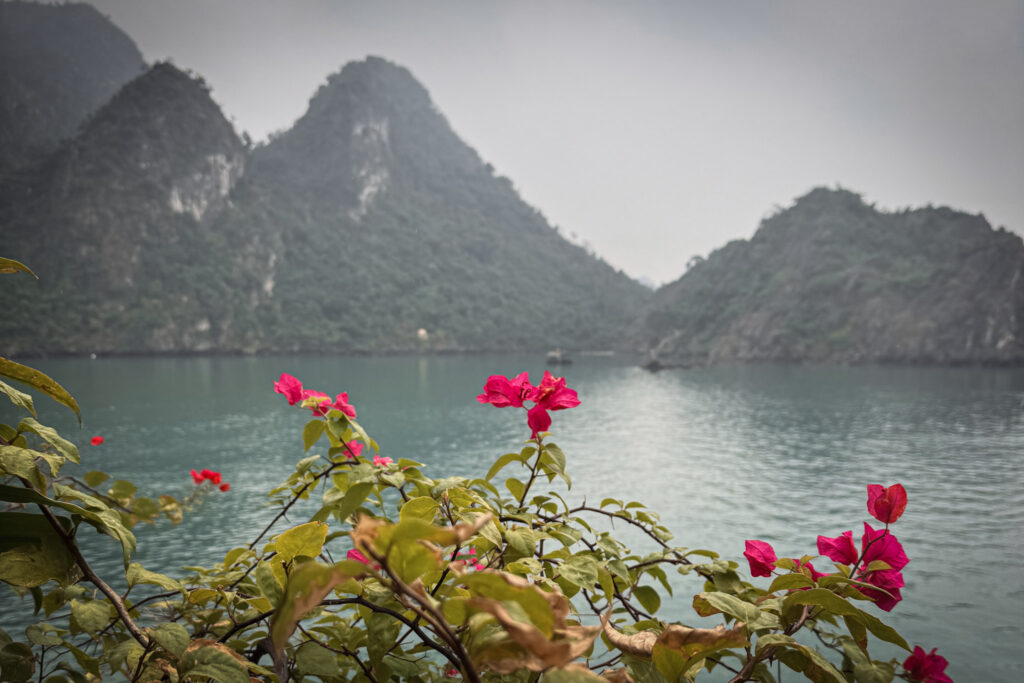
The last morning on the bay started with tai chi on the deck as the mist slowly lifted over the karst mountains. Whether you’re a tai chi person or not — and I was very much not — there is something about doing gentle morning stretches on a boat surrounded by one of the world’s most beautiful landscapes that just works.
Breakfast was, predictably, outstanding. A cooking class followed — learning to make traditional Vietnamese spring rolls with the kind of focus and concentration I wish I applied to other areas of my life. Worth every minute.
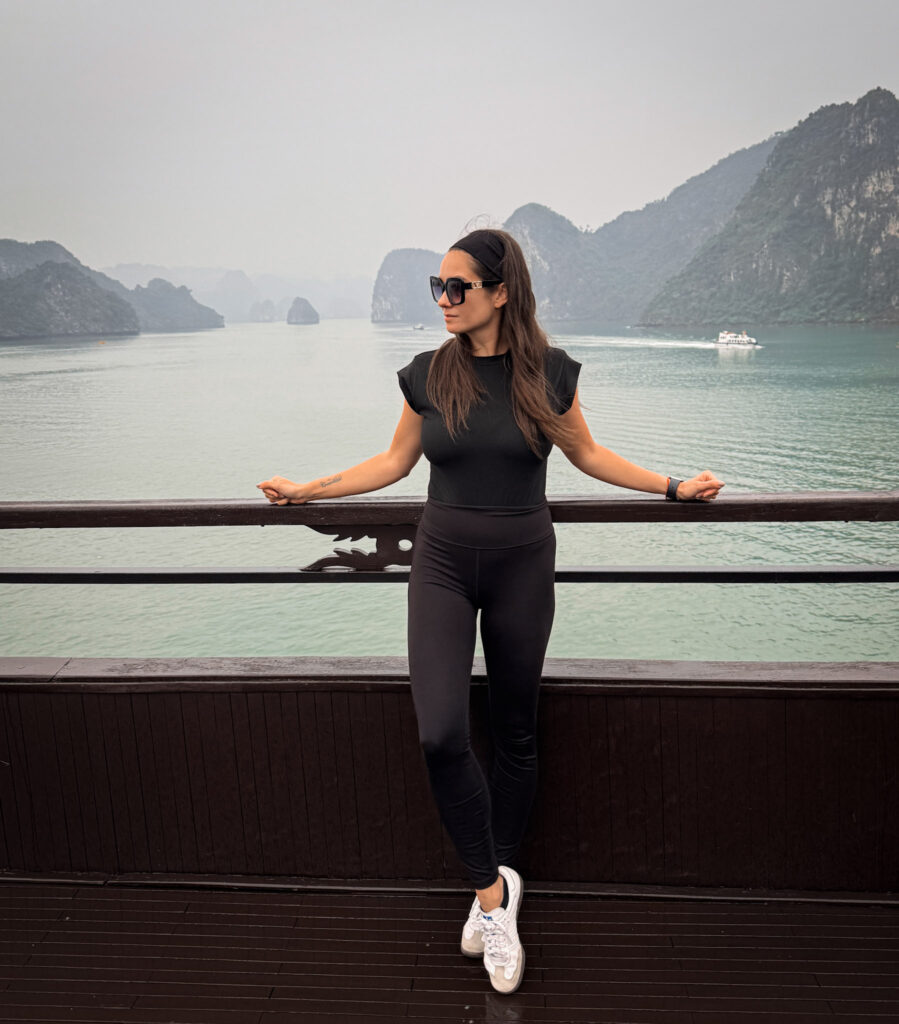
As the cruise made its way back to the harbour, I stood on the balcony watching the karst mountains slowly disappear into the mist behind us. December colours or not, Ha Long Bay is one of those places that genuinely lives up to every expectation. Sometimes the famous places are famous for a very good reason.
The bus back to Hanoi took a few hours, and by the time the city skyline appeared it was early evening. On a whim, we headed up to the hotel rooftop — and the timing couldn’t have been more perfect. The sunset over Hanoi was one of those completely unexpected travel moments that stops you in your tracks. The city stretching out in every direction, the sky turning gold and pink above the rooftops, the noise of the streets rising up from below. Magical is the only word for it.
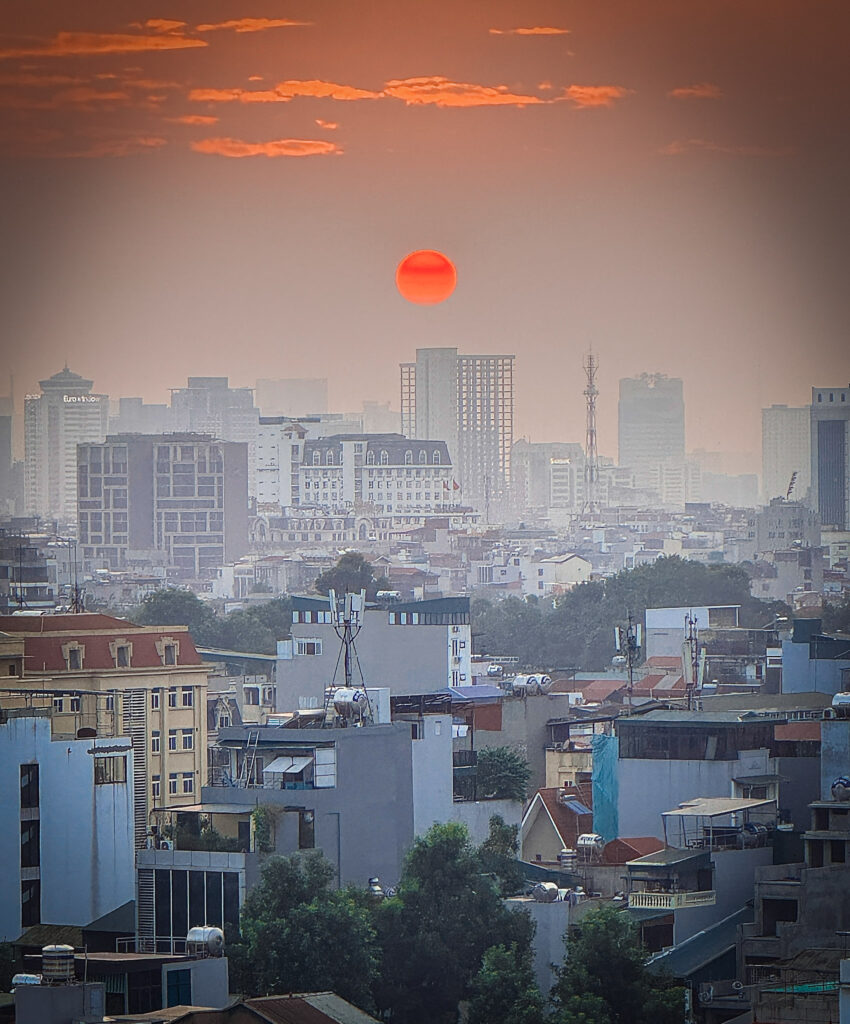
Sometimes the best moments of a trip aren’t the ones you planned. They’re the ones that just happen.
Jet Lag Jelly Tip: A gentle reminder — I visited Ha Long Bay in December, which is already the beginning of the rainy season. The colours in the photos won't be that vivid turquoise blue you see in summer pictures — the sky is greyer, the water greener, the mist thicker. But here's the thing: fewer crowds, cheaper prices, and the atmosphere in the bay is still completely magical. Sometimes the "off season" is just the right season with better value. Would I go back in December again? Without hesitation.
Day 8: Hanoi — Pagodas, Egg Coffee & One Last Train
The last day in any great city deserves to be done properly. No rushing, no packed itinerary — just soaking it all up one final time.
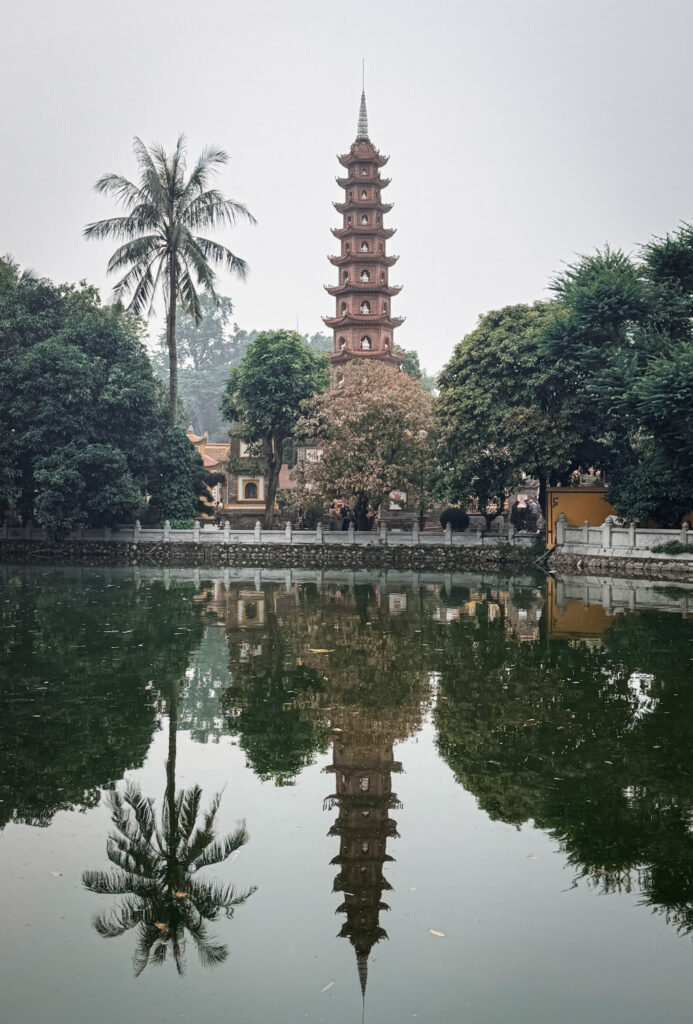
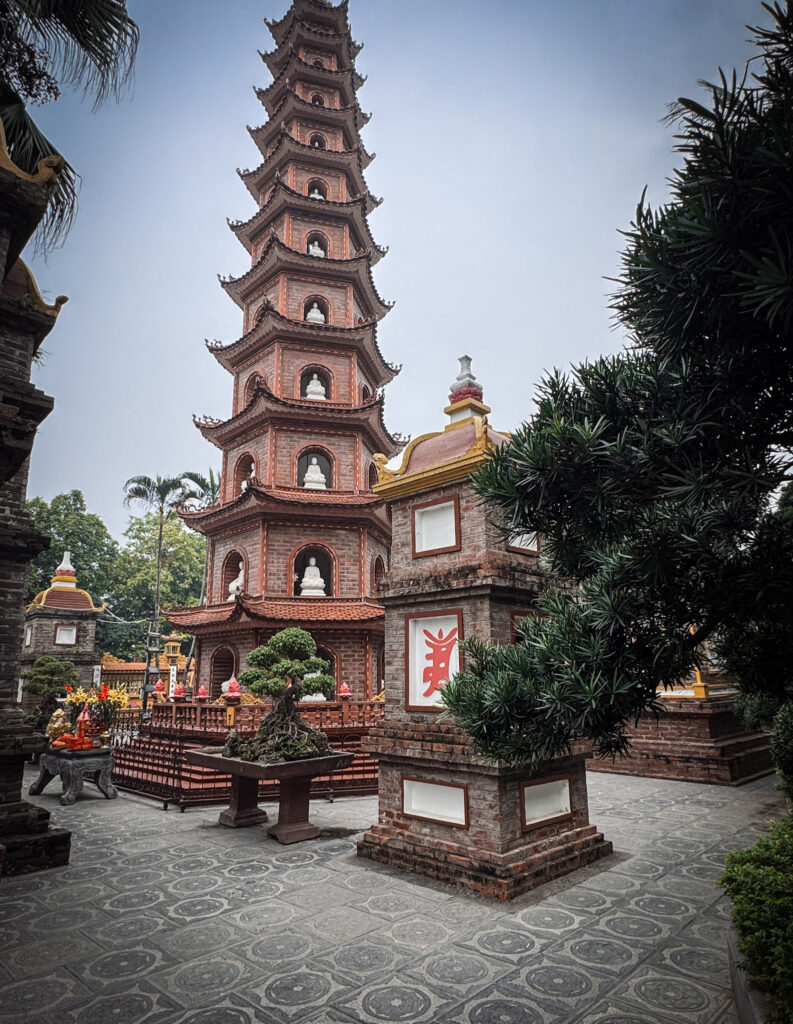
The morning started at Tran Quoc Pagoda — Hanoi’s oldest Buddhist pagoda, sitting serenely on a small island on West Lake. The iconic 11-story red brick tower with white Buddha statues on every level is one of those quietly beautiful places that somehow feels completely removed from the city chaos happening just outside its gates. A peaceful way to start a last day.
Useful Information: Free entry, open daily 8am to 4pm — on the 1st and 15th of the lunar month the pagoda opens from 6am to 6pm. Dress code strictly applies — shoulders and knees must be covered, no hats inside. A Grab or taxi from the Old Quarter takes 15–20 minutes; public bus routes 45 and 33 stop nearby on Thanh Nien Road.

Jet Lag Jelly Tip: For the best combination of light and low crowds, arrive at 7am on a weekday. The stupa catches the morning light beautifully against the still lake — and before the tour groups arrive, it's one of the most genuinely peaceful spots in all of Hanoi.
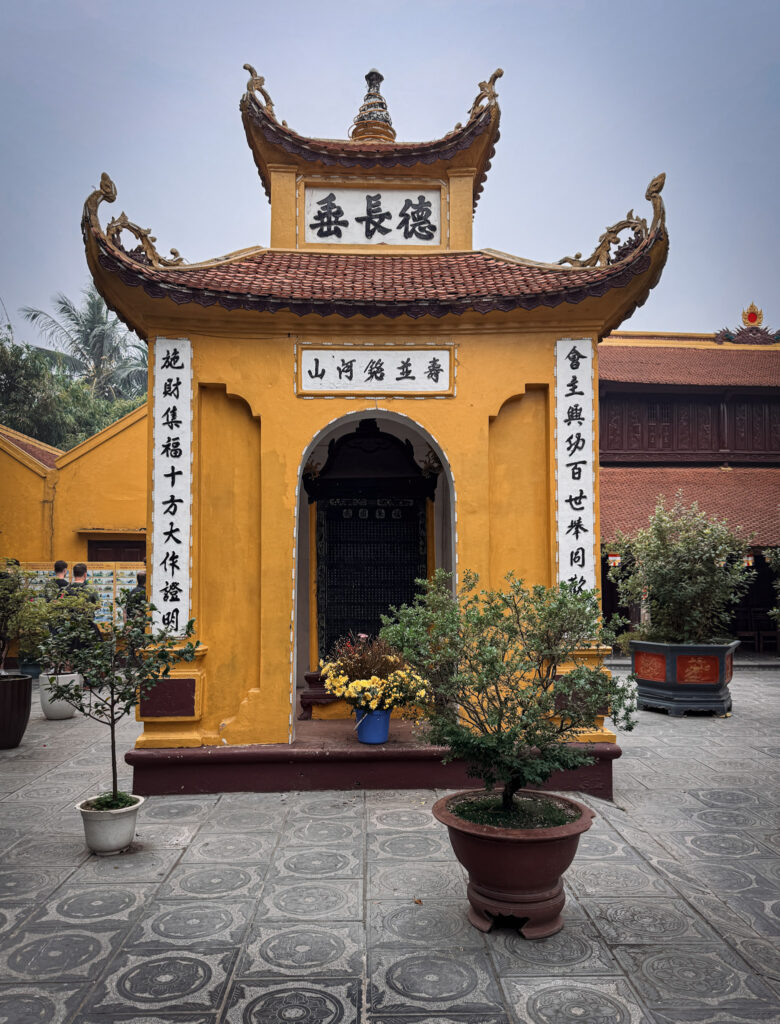
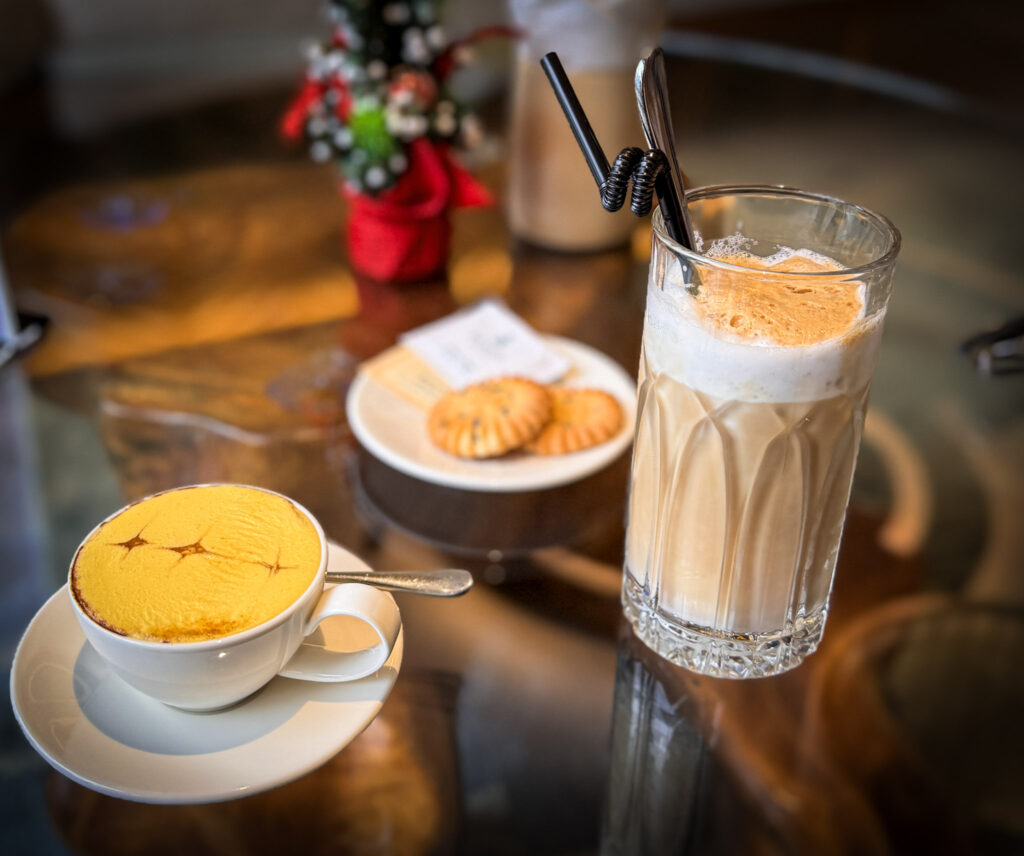
From there, it was time for something I’d been putting off the whole trip — Vietnamese egg coffee. And I have no idea why I waited so long. Thick, creamy, sweet, with a deep coffee kick underneath — it’s one of those things that sounds unusual until you taste it and immediately understand why Hanoi is famous for it. Converted. Completely and utterly converted.
Then back to the Old Quarter for shopping — and a gentle warning to anyone planning this: Vietnamese markets are dangerous for your luggage weight limit. Everything is incredibly affordable, especially the North Face gear. A winter hat and jacket later, I left considerably more equipped for cold weather and considerably less equipped for fitting everything into my bag. No regrets.
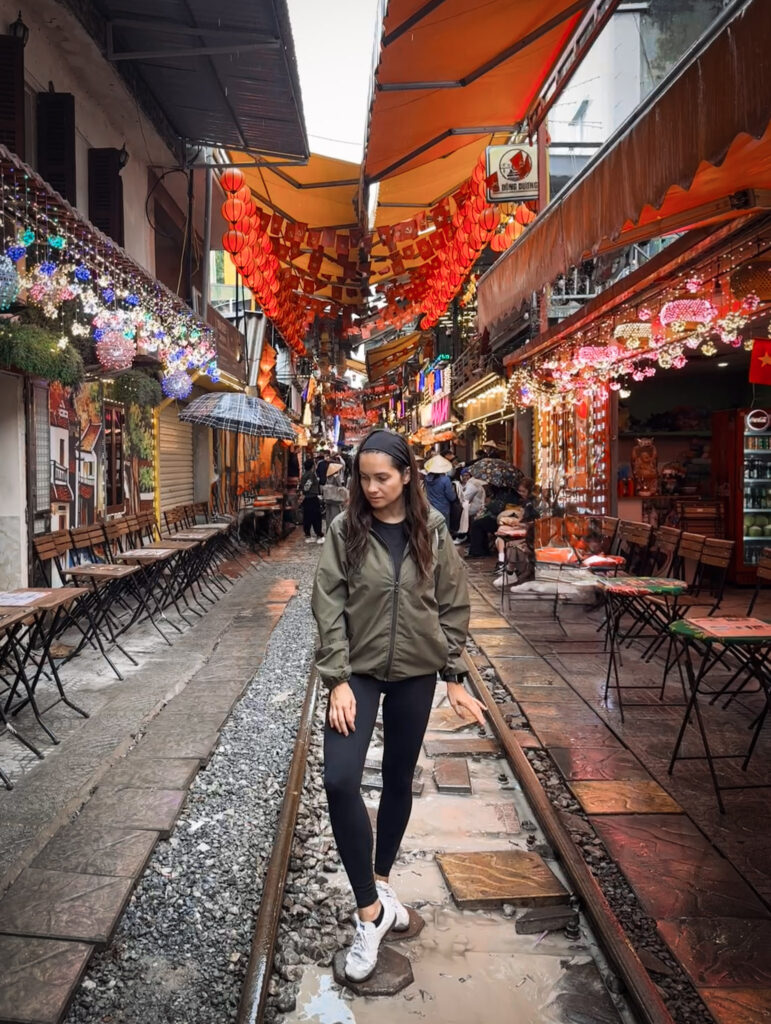
And of course — one final visit to Train Street. Because once is never enough. This time, two trains came through. The whole street erupted twice. Still chaotic, still brilliant, still absolutely worth sitting there with a drink waiting for the rumble to start. Some things don’t get old.
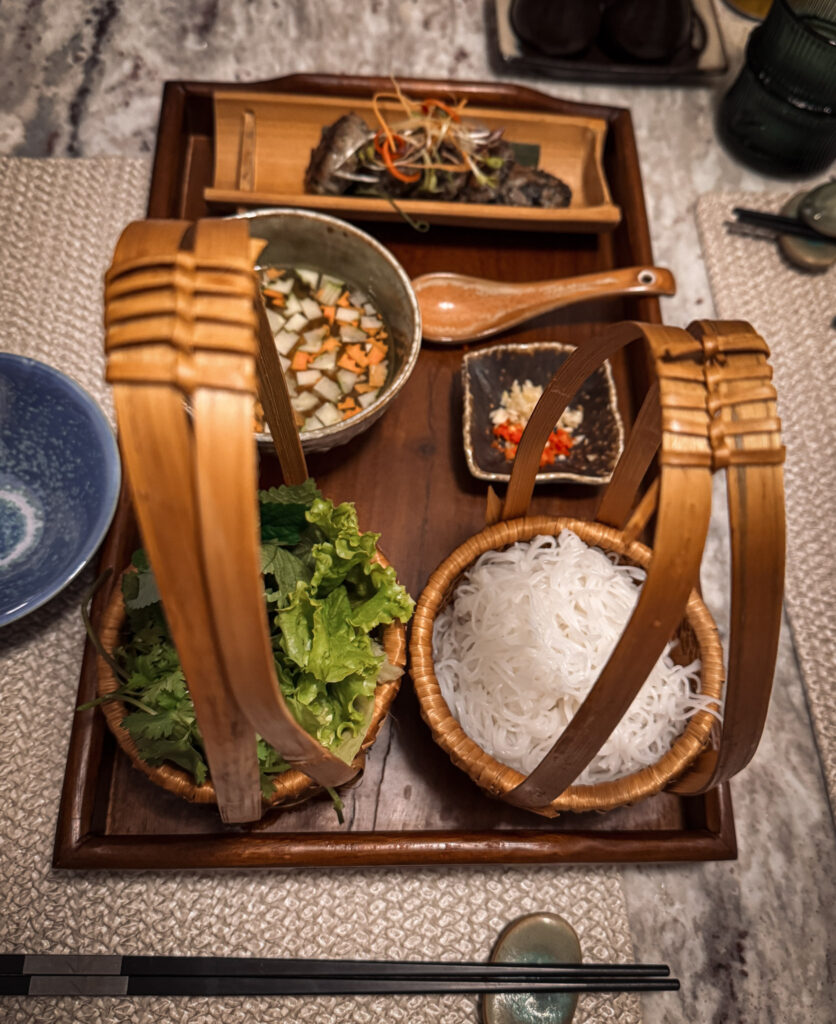
The evening ended with a last proper Vietnamese dinner — rice noodles served in bamboo baskets with fresh herbs, pan-seared salmon, and dipping sauces. Simple, delicious, and the perfect farewell meal to a country that had exceeded every single expectation.
Jet Lag Jelly Tip: Try the egg coffee before you leave Hanoi — don't be like me and leave it to the last day. Find a traditional café in the Old Quarter, sit down, and order one. You'll wish you'd had ten more during the trip.
Best Time to Visit Northern Vietnam
March–April and September–November are the sweet spot — mild temperatures, lower rainfall, and (in autumn especially) golden rice terraces around Sapa. A few things worth knowing:
- Winter (December–February): Cool and mostly dry in Hanoi (around 15-20°C), but Sapa can get genuinely cold, foggy, and even see snow — trekking trails can turn icy, so this isn’t the best window for the Sapa portion of this trip.
- Summer (May–August): Hot, humid, and Vietnam’s wettest stretch, with Ha Long Bay’s worst season landing around August-September, when typhoon season can bring storms and last-minute cruise cancellations.
- Spring and autumn (the sweet spot): Comfortable daytime temps, better trekking conditions in Sapa, and calmer skies for Ha Long Bay cruising — though it’s also the most popular window, so book hotels and cruises a few months ahead if you’re traveling then.
Jet Lag Jelly Tip: We actually visited in December (off-peak, rainy-season adjacent) and it worked out completely fine — greyer skies, cheaper prices, and Ha Long Bay still felt magical, just moodier than the postcard-blue photos. If budget matters more than perfect blue skies, don't rule out the shoulder months.
Where to Stay
Hanoi: the Old Quarter is the classic first-timer base — narrow streets packed with cafes, street food stalls, and easy walking access to Hoan Kiem Lake. It’s chaotic and loud, but that’s part of the charm. If you want something quieter while still being close, the French Quarter (just south of the Old Quarter) offers a calmer, more spread-out feel with colonial-era architecture, still an easy walk or short taxi from the main sights.
Sapa: most visitors base themselves in Sapa Town itself, which has the widest range of hotels and easy access to trekking routes into the surrounding valleys. If you want to be right in the rice terraces rather than in town, staying in a homestay in one of the surrounding villages (like Cat Cat or Ta Van) is a great alternative — you trade some convenience for a much more immersive, quieter setting.
Browse hotels in Hanoi or Browse hotels in Sapa to compare options for both stops.
Budget
Vietnam remains one of the best-value destinations in Southeast Asia, and Northern Vietnam is no exception. Rough daily estimates per person, excluding international flights:
- Backpacker: $30–50/day — hostel dorms, street food, sleeper buses, local transport
- Mid-range: $60–100/day — 3-star hotels, a mix of local and restaurant meals, the occasional taxi, one or two paid tours
- Comfort/luxury: $150-300+/day — boutique or 4-5 star hotels, private guides and transfers, premium experiences like a nicer Ha Long Bay cruise cabin
A few costs specific to this itinerary: the overnight sleeper bus to Sapa runs around $17-18 per person, the Hmong sisters trek is a genuinely incredible value at around €16, and a Ha Long Bay cruise cabin (1-2 nights) can range from budget shared cabins to serious luxury depending on the operator — this is usually where most of your daily average gets pulled upward.
FAQ
How many days do you need to visit Northern Vietnam? 8–10 days is ideal for a Northern Vietnam itinerary covering Hanoi, Sapa and Ha Long Bay. This gives you enough time to explore Hanoi, spend several days in the mountains around Sapa, and enjoy an overnight cruise through Ha Long Bay without rushing from one place to another.
What is the best itinerary for Northern Vietnam? For a first trip, a great route is Hanoi → Sapa → Hanoi → Ha Long Bay → Hanoi. I spent two days exploring Hanoi, three days in Sapa, and two days on a Ha Long Bay cruise. This combination gives you a good mix of city life, mountain scenery, local culture and one of Vietnam’s most iconic landscapes.
What is the best time to visit Northern Vietnam? The best time depends on what you want to see. September to November and March to May generally offer pleasant conditions for exploring Hanoi and trekking around Sapa. Winter can be cold and misty in Sapa, while summer is hotter and wetter. I visited in December, and although Ha Long Bay was mistier and less colorful than in summer photos, I loved the atmosphere and the smaller crowds.
How do you get from Hanoi to Sapa? One of the easiest options is an overnight sleeper bus. The journey takes around 5.5–6.5 hours and most buses leave Hanoi in the evening, arriving in Sapa early the next morning. I preferred the bus because it takes you directly to Sapa, while the train stops in Lao Cai, requiring another transfer to reach Sapa.
How many days do you need in Sapa? I recommend 3 days in Sapa. This gives you time to explore Sapa town, visit Cat Cat Village, trek through the Muong Hoa Valley and surrounding villages, and see some of the area’s mountain viewpoints. If you love hiking and want to explore further, you could easily stay longer.
Is Sapa worth visiting? Absolutely. Sapa was one of my favorite parts of Northern Vietnam. The combination of misty mountains, rice terraces, ethnic minority villages and local culture makes it completely different from Hanoi and Ha Long Bay. The scenery alone is worth the trip, but the local trekking experience made it even more memorable for me.
Is Ha Long Bay worth visiting? Yes. Even though Ha Long Bay is one of Vietnam’s most famous tourist destinations, it genuinely lives up to the hype. Cruising between the dramatic limestone karsts, kayaking through hidden lagoons and watching the landscape disappear into the mist is an unforgettable experience.
Is one night enough for a Ha Long Bay cruise? One night is enough to see the highlights, especially if you’re short on time. However, if your schedule allows, I would recommend a 2-night cruise. One night can feel surprisingly rushed, while an extra night gives you more time to enjoy the scenery, activities and the ship itself without constantly watching the clock.
Can you visit Hanoi, Sapa and Ha Long Bay in one trip? Definitely — and they work surprisingly well together. Hanoi gives you the culture and energy, Sapa adds mountains and local experiences, and Ha Long Bay finishes the trip with a completely different landscape. Together, they make one of the best introductions to Northern Vietnam.
Summary
Vietnam had been on my list for a long time. And Northern Vietnam specifically delivered everything I hoped for and then some.
Hanoi chaos. Sapa mist. Ha Long Bay magic. Three completely different experiences, three completely different vibes, all within one trip. That’s the thing about Northern Vietnam — it never lets you settle into one mood for too long. Just when you think you’ve figured it out, it surprises you again.
The overnight buses, the mountain roads, the sleepless nights, the squid that got away — all of it was worth it. Every single kilometer.
If you’re thinking about going — go. Don’t wait for the perfect season, the perfect budget, or the perfect moment. Northern Vietnam will meet you wherever you are and show you something extraordinary.
Just maybe pack a warmer jacket than you think you need. The mountains don’t care about your packing list.
Sleep later. Explore now.
Part of my Southeast Asia coverage — check out my Koh Rong & Angkor Wat: Cambodia’s Greatest Hits, Angkor Wat & Beyond: My Favorite 10 Temples, Ranked, and Japan in 12 Days: Worth the Jetlag posts too if you’re planning a bigger trip across the region.