
White Sands National Park looks like a snowy landscape in the middle of the desert. It’s the world’s largest gypsum dune field, and the dunes are bright white, soft, and cool to the touch, even when the sun is strong. It feels like a different planet, and it’s one of the most unusual places we have ever visited.

The entrance fee is $25 per vehicle, valid for seven consecutive days, and payable at the entrance booth on Dunes Drive. If you arrive without a car, for example on foot or by bike, the fee is $15 per person. Entrance fees are valid for reentry for seven consecutive days, and the America the Beautiful annual pass is accepted.

The park is generally open year-round from 7 am to sunset, so you can stay for the colors of the evening, but hours vary by season and the visitor center closes earlier than the park, so check the official website before you go.

Check the park’s website for military testing closures before you drive in, since they can close the road for a short time, and arrive well before sunset so you have time to park and walk
We came here on our Texas and New Mexico road trip, in the afternoon after visiting Carlsbad Caverns, and stayed to watch the sunset, when the white sand turned pink and orange. It was the perfect way to end the day, and the weather in October was just right: still warm, but totally bearable.
In this guide, I’ll share how to get there, what to do in the park, the best time to visit, and some tips to plan your own trip, so you can enjoy the dunes and the sunset as much as we did.

Dunes Drive: The park has one main road, the 8-mile Dunes Drive, which is paved for the first 5 miles and hard-packed gypsum for the last 3. Along the way, there are parking areas, picnic spots, and trailheads, so you can stop wherever the view looks good.
Things to do:

- Walk onto the dunes: The easiest way to experience White Sands is to park, take your shoes off, and walk up a dune. Barefoot is a great way to feel how cool the sand is.

- Sledding: The best sledding runs are near the Alkali Flat trailhead and the larger dunes near the end of the loop, and you can wax the sled before each run.
redawning

- Hiking: The Alkali Flat Trail is the most demanding option, running five miles round trip across open dunes with no shade. There are also shorter trails, such as the Dune Life Nature Trail, a 1-mile loop.

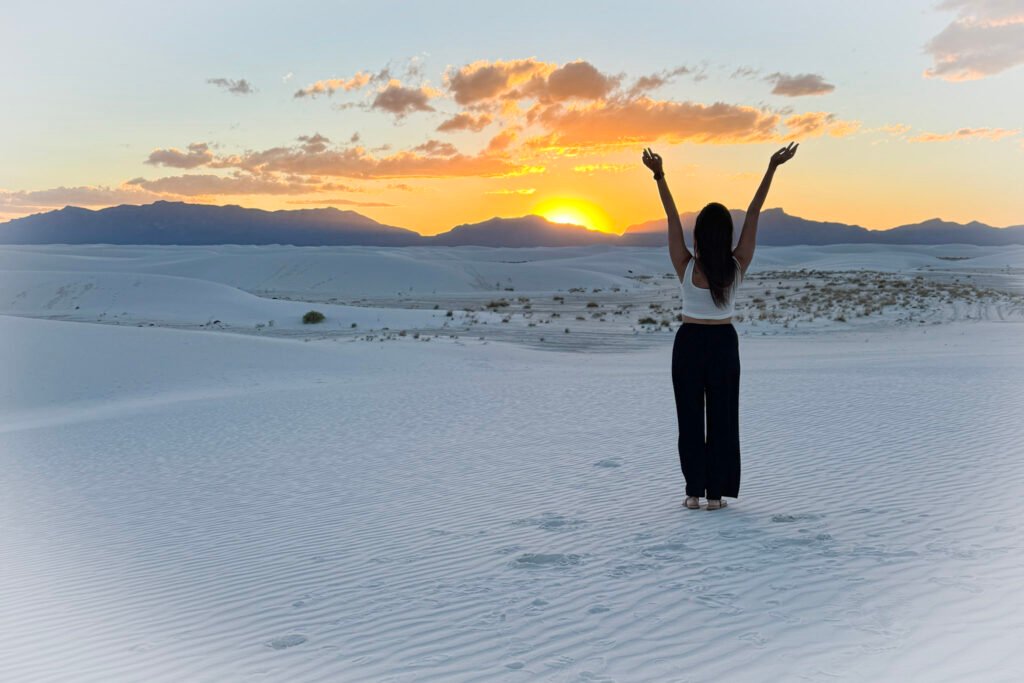
-Watch the sunset: This is the best time of day to be here. The white sand goes pink, then blue, as the sun drops behind the San Andres Mountains, and the shadows grow long across the dunes. Rangers also offer guided sunset strolls, so check the schedule if you want to join one.
Jet Lag Jelly Tip: Check the sunset time and the park’s closing hours before you arrive, and bring a camera and sunglasses. The white sand is very bright, even in the late afternoon.
1. Dune Life Nature Trail

This is the first chance to walk on the sand. It’s a 1-mile (1.6 km) loop that takes about an hour, and it’s rated moderate.

The trail goes up and down the dunes through the interdunal area, the transition zone between the desert scrubland and the sand dunes. It also takes you up and over two of the dunes, so the soft sand makes it more tiring than it looks. Look for signs of small nocturnal mammals, birds, and reptiles.


Jet Lag Jelly Tip: Bring water, even for a short loop, and wear sunglasses, since the white sand is very bright.
2. Playa Trail
This is the shortest and easiest walk in the park, and a good first stop. It’s a 0.5-mile (800 m) round trip, and it leads to a dried lakebed, or a playa, with informational panels that explain what it looks like and what kinds of animals it attracts throughout the seasons.

A playa is a shallow depression that fills temporarily with rainwater from storms.
Jet Lag Jelly Tip: Perfect if you have little time, or want a quick stop with minimal effort. Stay on the trail, since the playa is fragile.
3. Sunset Stroll
A ranger-led walk at sunset, marked on the park’s Dunes Drive map.

It’s a relaxed way to learn about the dunes while the light changes. We stayed to watch the sunset, when the sand turns pink and orange and the shadows grow long.
Jet Lag Jelly Tip: Check the schedule on the park’s website, since ranger programs change by season, and arrive early to find a parking spot.
4. Panoramic White Dunes View

The view here is spectacular. You can see dunes all around you, like in 360 degrees, with the white sand rolling in every direction until it meets the sky.

It’s the moment when you really understand how big the dune field is, and it feels like standing in a different world.

Jet Lag Jelly Tip: Take your time here, and turn around slowly, since every direction looks a little different. It’s the best place for photos, especially in the late afternoon when the shadows make the dunes look even more dramatic. Bring sunglasses, since the white sand is very bright.
5. Interdune Boardwalk

An easy, short walk of 0.4 miles (650 m). The trail is fully accessible for wheelchairs and strollers, an elevated boardwalk through a fragile interdune area, with signs and benches along the way. Interdune areas are where all plant life in the dune field starts. It’s a good choice if walking in soft sand is not an option.

Jet Lag Jelly Tip: The boardwalk has been listed as closed in some recent guides because of the safety corridor restrictions, so check the park’s website for the current status before you go.
6. Alkali Flat Trail
This is the longest and most challenging hike in the park. It’s about 5 miles (8 km) round trip, takes around 3 hours, and is rated strenuous.

The trail takes you through the Heart of the Sands, up and over dunes, and ends at the edge of the Alkali Flat. Don’t be fooled by the name, since this hike is anything but flat. The reward is endless views of white dunes.

Jet Lag Jelly Tip: There is no shade, and the markers can be hard to see, so bring plenty of water, sun protection, and a map, since the park has limited cell service, and the colored trail markers may be hard to spot or blown away by the wind. Start early, or go in the late afternoon, and pay attention to the signs, as we did in Guadalupe Mountains.
Where to Stay
There is no lodging within White Sands National Park, so you need to stay in a nearby town. We stayed in Alamogordo, the closest and easiest base, about 20 to 25 minutes from the park. It’s the best choice if you want to stay for the sunset, since you don’t have a long drive back in the dark.
If you want more hotels and restaurants to choose from, Las Cruces is about an hour away.
You can check prices and availability for hotels in Alamogordo on Booking.com.
Best Time to Go
We visited in October, in the afternoon, and stayed for the sunset. The weather was perfect: still warm, but totally bearable.
Fall is a great choice. One guide says October is hard to beat: average highs of 79°F (26°C), settled weather, and the last of the full-moon nights. Another notes that the crowds start thinning out as early as the beginning of September.
Spring (March to May)
Spring brings wildflowers but also strong winds and spring-break crowds. Spring can bring strong winds and blowing sand. It’s the most popular time to visit, so expect more people.
Summer (June to August)
Summer turns hot, with highs in the 90s to 100s °F (32 to 38 °C.), and afternoon monsoon thunderstorms roll in July and August. The heat can be dangerous, and the white sand reflects the sun. On the plus side, during full-moon nights from May through October, the park stays open an extra few hours, so it’s a magical time for sunset and moonlight lovers.
Winter (December to February)
Winter is quiet, and the cheapest time to visit, but the nights can be below freezing. Go in the middle of the day, and pack layers.
Our pick: October, or early spring.
Jet Lag Jelly Tip: Whatever the season, visit at dawn or late afternoon to avoid the midday heat and to get the best light on the dunes. Bring layers, since the temperature drops quickly after sunset.
FAQ
How long do you need at White Sands? It’s a half-day to full-day stop. We visited in the afternoon after Carlsbad Caverns and stayed for the sunset, which was enough to see the main highlights.
How much is the entrance fee? $25 per vehicle, valid for seven consecutive days. Check the park’s website for the current price.
What are the opening hours? The park is generally open year-round from 7 am to sunset, but hours vary by season, so check before you go.
Do you need a 4×4 car? No. A regular car is fine, since the Dunes Drive is paved for the first 5 miles and hard-packed gypsum for the last 3.
Can you go sledding? Yes. You can rent or buy a waxed plastic saucer at the gift shop and slide down the steep dune faces, a classic White Sands rite. It is definitely super fun.
Does the park close for missile tests? Yes, sometimes. During missile tests, the park, parking areas, and Highway 70 are closed. Check the park’s website for closures before you plan your day, and consider staying in Alamogordo to reduce the effect of a closure.
Where should you stay? There is no lodging within the park. We stayed in Alamogordo, the closest town, about 20 to 25 minutes from the park. See the Where to Stay section above.
Is it hot on the sand? The dunes are made of gypsum, so the sand stays cool underfoot, even in the sun. But the air can still be very hot in summer, so bring plenty of water, sunglasses, and sun protection.
Can you combine it with Carlsbad Caverns? Yes, that’s what we did. The drive from Carlsbad takes about 2.5 to 3 hours, so start early at the caves, and plan to reach White Sands in the afternoon, in time for the sunset.
Summary
White Sands National Park is one of the most unusual places we have ever visited: bright white dunes that stay cool underfoot, and a landscape that looks like snow in the middle of the desert. We stayed for the sunset, when the sand turned pink and orange, and it was the perfect end to the day.
If you’re planning a visit, bring plenty of water and sunglasses, check the park’s website for closures and opening hours, and arrive early enough for the sunset. Have you been to White Sands, or is it on your list? Let me know in the comments!
Sleep later. Explore now.
Looking for more inspiration? White Sands was one stop on our Texas and New Mexico Road Trip. If you love national parks in the desert, read our guide to Big Bend National Park, and have a look at my Top National Parks from Las Vegas.